Quick answer
A 4-2 is a volleyball system with four hitters and two setters. The setters line up across from each other, and the setter in the front row sets from zone 2 or 3. That gives a short, easy set and two front-row attackers in every rotation. It is popular with 10U to 14U teams.
What is a 4-2 volleyball rotation?
A 4-2 (also written 4 2) uses four hitters and two setters. The setters line up across from each other, so one is always in the front row and one in the back row. The front-row setter sets. She moves to the right side of the net, to zone 2 or zone 3, and sets the outside hitter.
That makes the 4-2 easy to run:
- The setter is already at the net, so she does not have to run in from the back row.
- The pass does not need to reach a perfect spot; the setter is close.
- There are only two front-row attackers, so the setting choice is simple.
The trade-off is the offense: two attackers are easier to block than three. That is fine for youth volleyball, where a good pass and a good set win most rallies.
Why the 4-2 rotation in volleyball suits youth teams
Coaches pick the 4-2 for 10U to 14U teams for a few reasons:
- Two players learn to set. Neither one has to set all six rotations.
- Simple rules for kids. “The front-row setter sets” is easy to remember and easy to check.
- A bridge to bigger systems. The lineup order is the same as a 6-2, so you can move up without changing the lineup.
If your players cannot pass or set yet, start with the 6-6 system for beginners, where whoever is in the setting spot sets. Many youth leagues also use a serve limit (for example 3 or 5 serves in a row); the scoreboard supports that.
The front-row setter
Each setter sets for three rotations: while she is in zones 4, 3 and 2. In zone 4 she has the longest move, because overlap rules keep her to the left of the zone 3 player at the serve. A smart start is to stand close to the net, just left of the middle, and slide right as the ball is served.
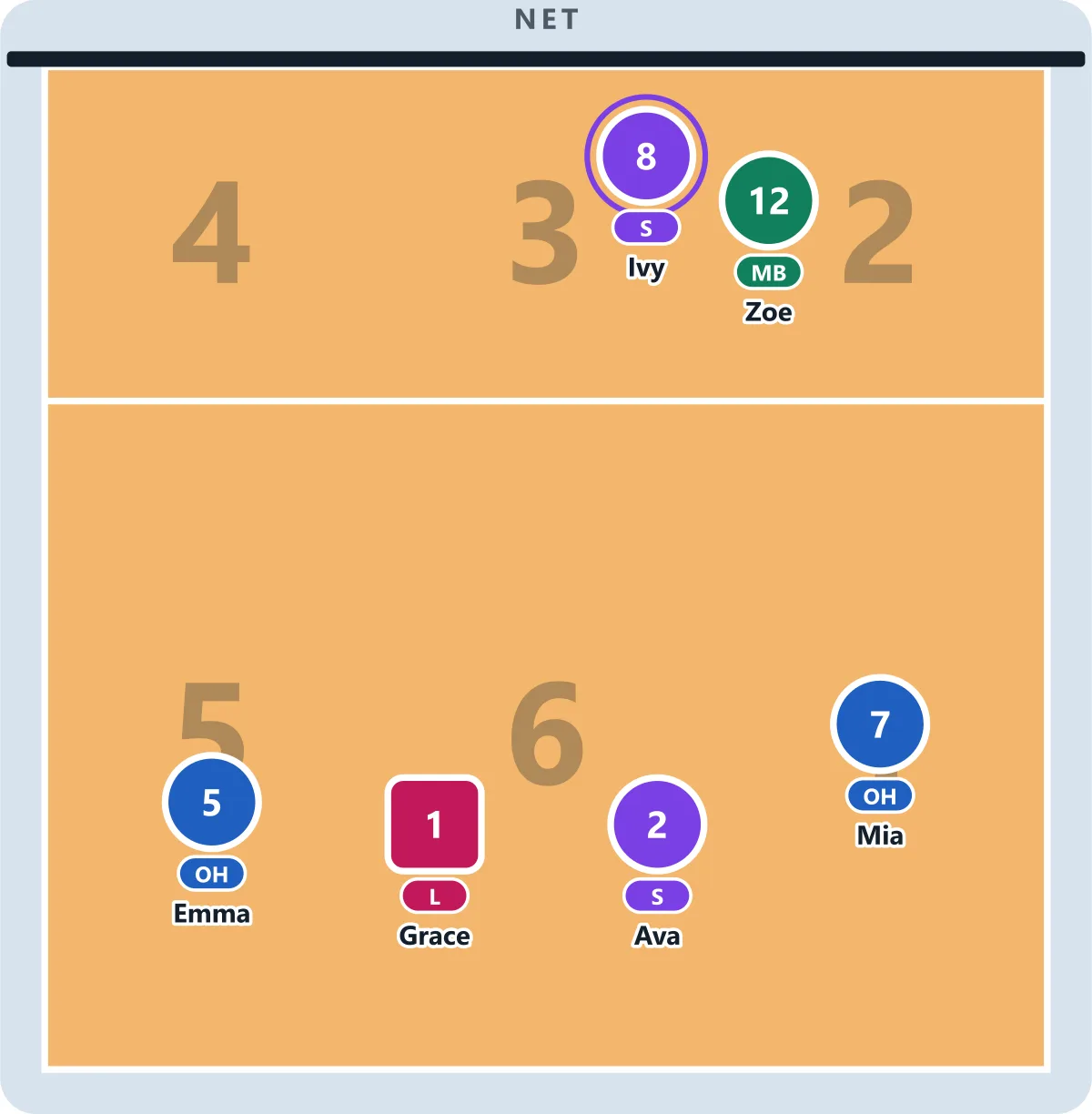
When the setter is in zone 3 or zone 2 she is already at the target, which is why the 4-2 feels so smooth in those rotations.
The 3 serve receive patterns
A 4-2 has only three serve receive patterns, because Rotations 4, 5 and 6 repeat Rotations 1, 2 and 3 with the setters swapped. With 4 passers, the three back-row players pass, plus the front-row hitter who is not at the net.
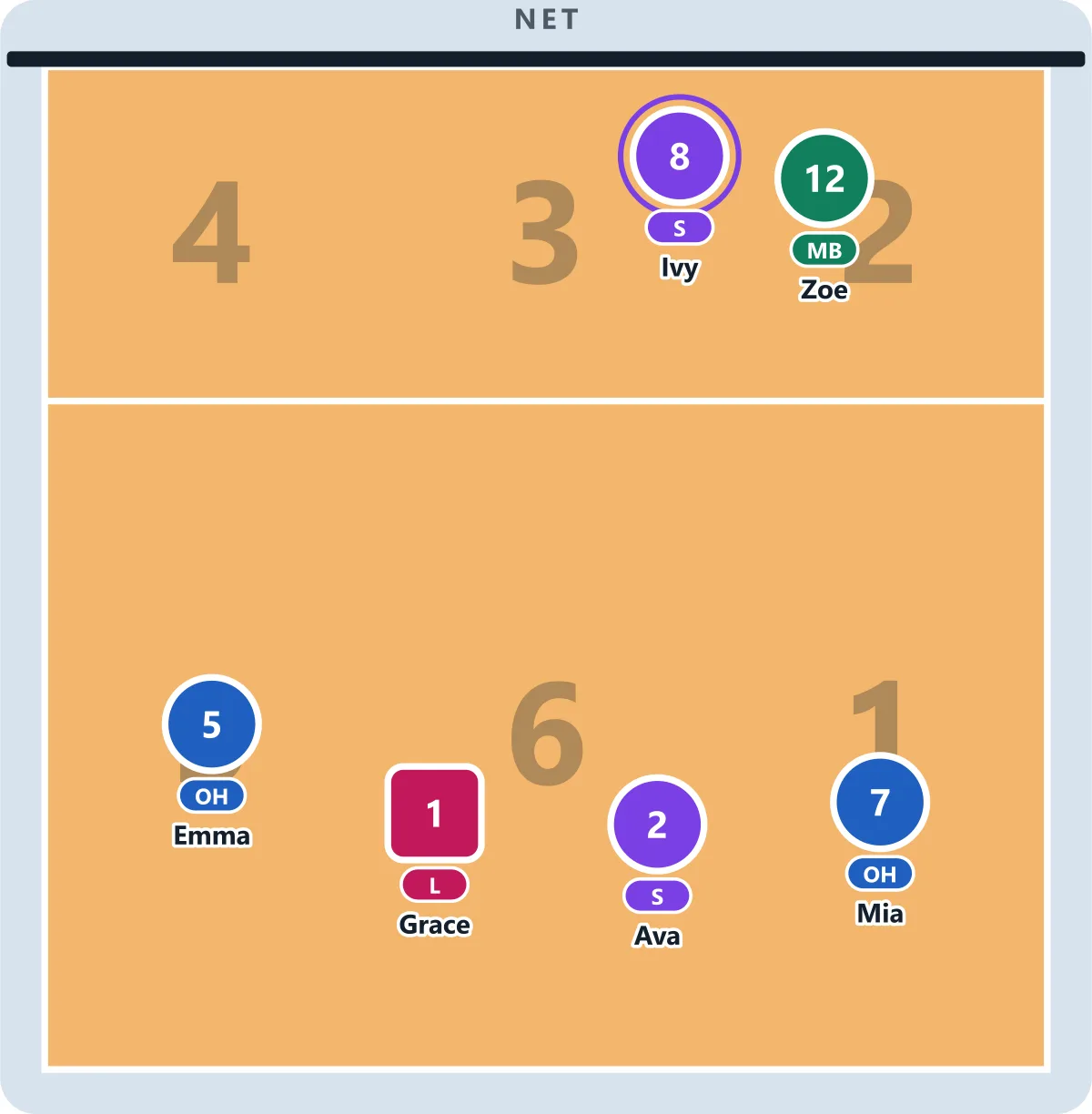
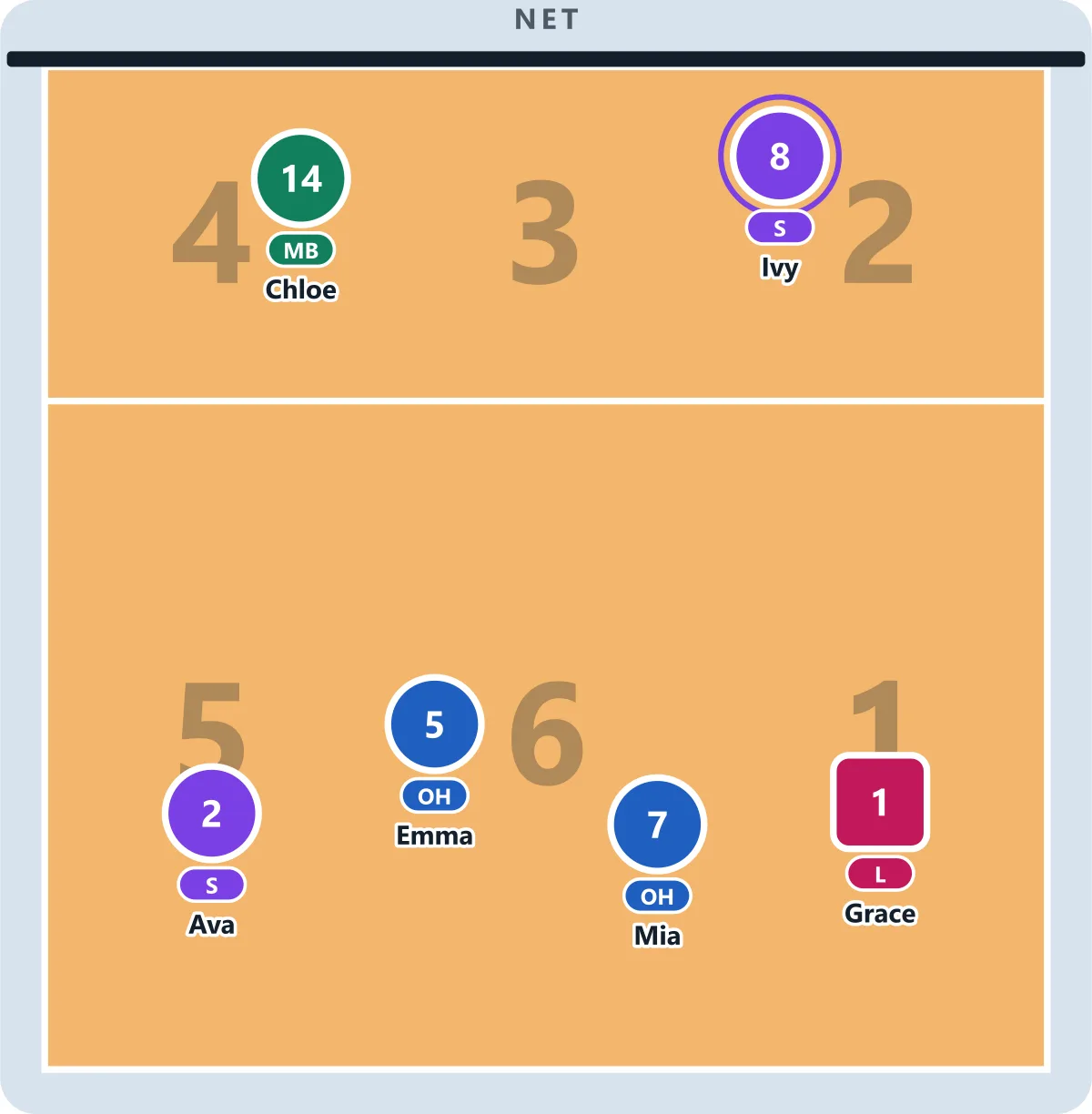
- Setter in zone 4. The middle stands just to her right; the right-front hitter passes in the right lane.
- Setter in zone 3. She starts at the target; the left-front hitter passes in the left lane.
- Setter in zone 2. She starts at the target; the middle hitter stays at the net on the left, and the zone 3 hitter passes.
All 6 rotations of the 4-2 rotation volleyball
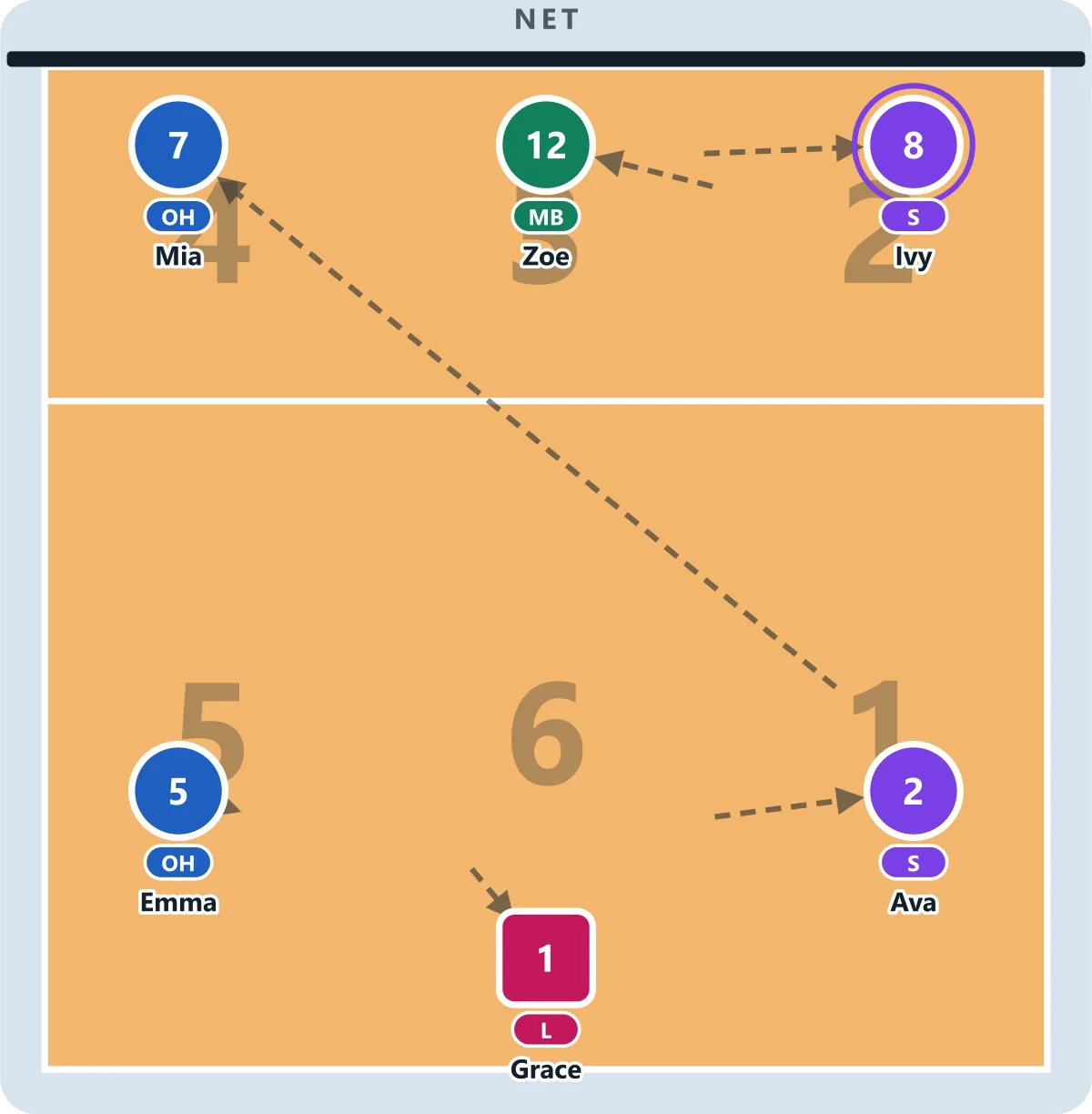
Rotations are named by S1’s zone (Rotation 1 = S1, Ava, in zone 1). In Rotations 1-3 Ivy (#8) is front row and sets; in Rotations 4-6 Ava (#2) sets.
| Rotation | Front-row setter | Her zone | Attackers |
|---|---|---|---|
| 1 | Ivy (#8) | 4 | Zoe, Mia |
| 2 | Ivy (#8) | 3 | Emma, Zoe |
| 3 | Ivy (#8) | 2 | Chloe, Emma |
| 4 | Ava (#2) | 4 | Chloe, Emma |
| 5 | Ava (#2) | 3 | Mia, Chloe |
| 6 | Ava (#2) | 2 | Zoe, Mia |
The back-row setter is a regular back-row player: she passes and digs. That is a great way for setters to learn the rest of the game.
A simple 4-2 practice plan
Young players learn rotations by doing them many times. A 20-minute block that works:
- Walk-through (5 minutes). Put the team in Rotation 1. Ask, “Who sets?” Everyone points to the front-row setter. Rotate and ask again, six times.
- Setter release (5 minutes). The coach tosses a free ball. The front-row setter moves to the target and sets the outside hitter. Rotate after every ball.
- Serve receive (10 minutes). Live serves to the four passers. Freeze on the serve contact once per rotation and check that front-row players are in front of their back-row partners.
Print player cards from the generator so every player can look at her own spot between drills.
Common 4-2 mistakes
- The back-row setter runs in to set. In a 4-2 she passes. Only the front-row setter sets.
- The setter in zone 4 starts too far right. At the serve she must be to the left of the zone 3 player. She can slide right as soon as the ball is served.
- Everyone passes at once. With four passers, give each player a clear lane and a “mine” call.
- Hitters wait at the net. The left-front hitter who passes must still get out to her approach spot after the pass.
Moving up to a 6-2 or 5-1
When passing gets better, move up:
- To a 6-2: keep the same lineup. Now the back-row setter sets, and the front-row setter hits. You go from two front-row attackers to three. See the 6-2 rotation.
- To a 5-1: pick your best setter and replace the other setter with an opposite hitter. Your setter now sets every rotation. See the 5-1 rotation.
Not sure which fits? The rotation systems compared page has a 3-question picker. Build your own 4-2 in the volleyball rotation generator or print the 4-2 rotation sheet (PDF).
Frequently asked questions
What is a 4-2 in volleyball?
A 4-2 is an offense with four hitters and two setters. The two setters line up across from each other, and the one in the front row sets. Because she sets from the net, the set is short and the pass does not need to be perfect. You get two front-row attackers in every rotation. It is a common first system for youth teams.
How do you run a 4-2 rotation in volleyball?
Put the setters across from each other: S1, OH1, MB1, S2, OH2, MB2 in serving order. In each rotation the front-row setter moves to the right side of the net (zone 2 or 3) to set. The back-row setter plays like any back-row player and passes. Teach the three serve receive patterns, because Rotations 4, 5 and 6 repeat 1, 2 and 3.
How do you teach a 4-2 volleyball rotation?
Teach it as three patterns, not six. Walk the setter from her start spot to the target in each pattern, then add passers. Use a simple rule your players can say out loud: "front-row setter sets". Practice the setter release with a toss before you add a live serve, and freeze at the serve to check overlap.
Is a 4-2 good for beginners?
Yes, once players can pass and set a little. A 4-2 is the next step after a 6-6, where everyone takes a turn setting. The setter is always at the net, the run is short, and young hitters only need to hit from the outside. It is a good fit for 10U to 14U teams with two players who like to set.
What is the difference between a 4-2 and a 6-2?
Both use two setters across from each other. In a 4-2 the front-row setter sets, so you have two front-row attackers. In a 6-2 the back-row setter sets, so the front-row setter can hit and you have three attackers. The 6-2 is a stronger offense but needs better passing and a setter who can run in from the back row.
Can the setter attack in a 4-2?
Yes. The setter is in the front row, so she may attack the second ball, which is a great way to score when the block cheats outside. Teach a simple tip to the open spot. The back-row setter cannot attack the ball above the net from in front of the attack line, but in a 4-2 she is passing, not setting.
How many passers should a 4-2 use?
Four passers is the most common choice, because young teams need more players covering the court. The three back-row players pass, plus the front-row hitter who is not at the net. As passing gets better, move to three passers and keep one more hitter at the net. The builder on this site shows 3, 4 and 5 passer patterns.
Rules checked
Rule sets used on this page: NFHS (high school) 2026-27, USAV (club) 2025-27, NCAA (college) 2026 and FIVB (international) 2025-28. Where leagues differ, the tool makes it a setting. Always check your league or state association.
- Overlap: server: USAV 7.4; NFHS 6-4-3
- Overlap: which pairs: USAV 7.4.2-7.4.3; NFHS 6-4-3
- Youth: serve limit: Gilbert AZ, Rogers AR rec rules
Last reviewed: by EmproIT. See how we check the rules.