Quick answer
A volleyball rotation sheet shows where every player stands in each of the six rotations, usually in serve receive, on one page. Coaches keep it on the bench clipboard to check positions before each serve, and players use it to learn their spots. Print it filled from your lineup or blank to fill by hand.
What a volleyball rotation sheet is
A rotation sheet is your team’s map: six small courts, one for each rotation, with every player’s number in her spot at the serve. Most coaches show serve receive, because that is where positions get complicated, and add arrows to base defense.
Rotation sheets for volleyball come in two kinds:
- Filled: made from your lineup, with names and numbers. Use it in matches and practice.
- Blank: courts with zone circles to fill by hand. Use it for planning and teaching.
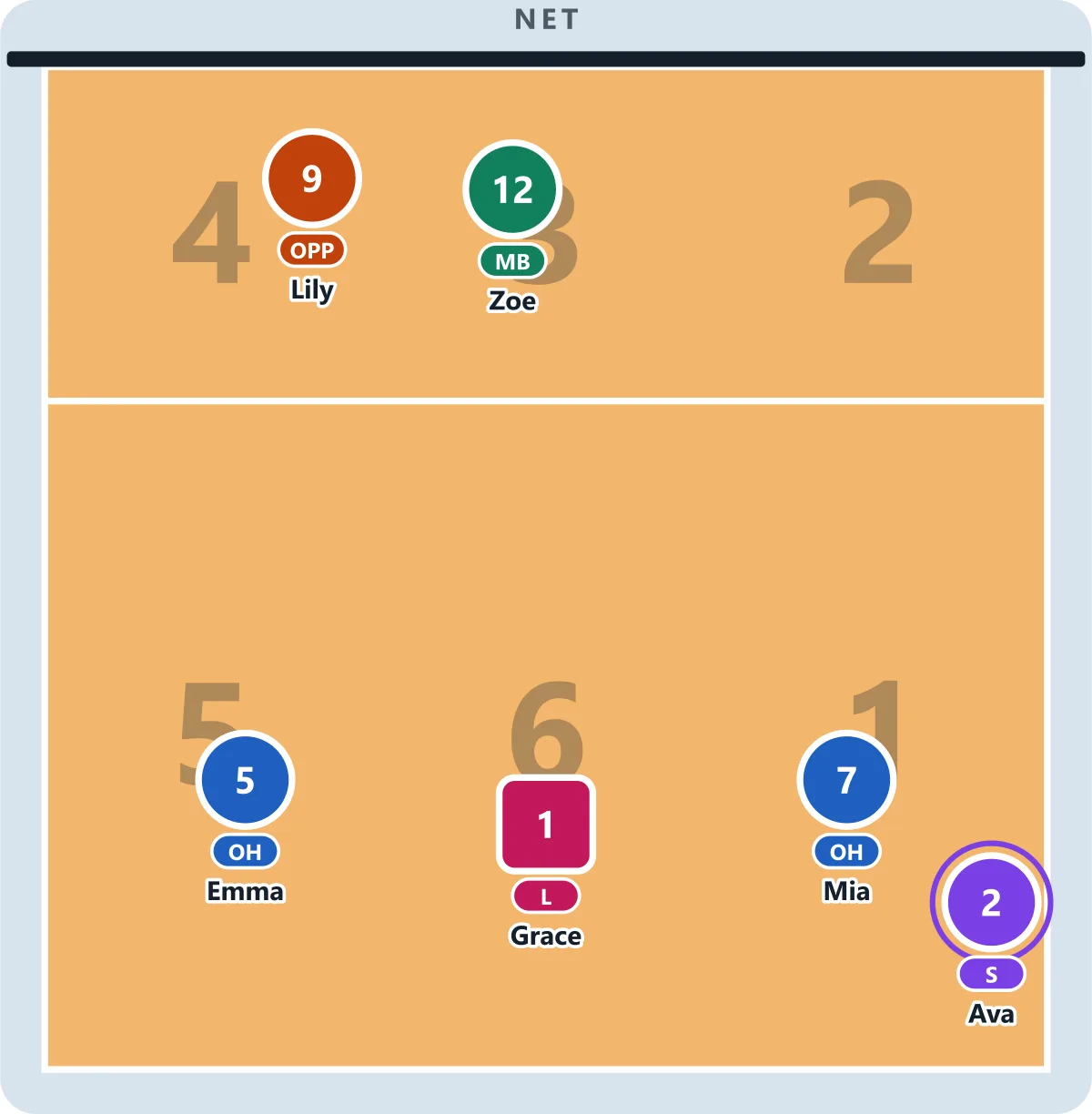
How to use a rotation sheet on the bench
- Before the set: check the sheet against the lineup sheet you hand in. The starting rotation must match.
- Before each serve: glance at the current rotation. Is everyone legal? Is the libero in for the right player?
- On a side-out: look at the next rotation and tell the new server and the player rotating into the front row.
- During timeouts: show players the next two rotations, especially your weak rotation.
- Between sets: if you change the starting rotation, print a fresh sheet so the numbering matches.
A sheet that numbers rotations by the setter’s zone (Rotation 1 = setter in zone 1) reads the same every match. The generator can also number them in the order you play from the start of the set.
Volleyball court diagram with zones
The blank court diagram shows zones 1 to 6 with a circle in each. It is the best teaching tool for young teams: write each player’s number in her circle and rotate the numbers clockwise together.
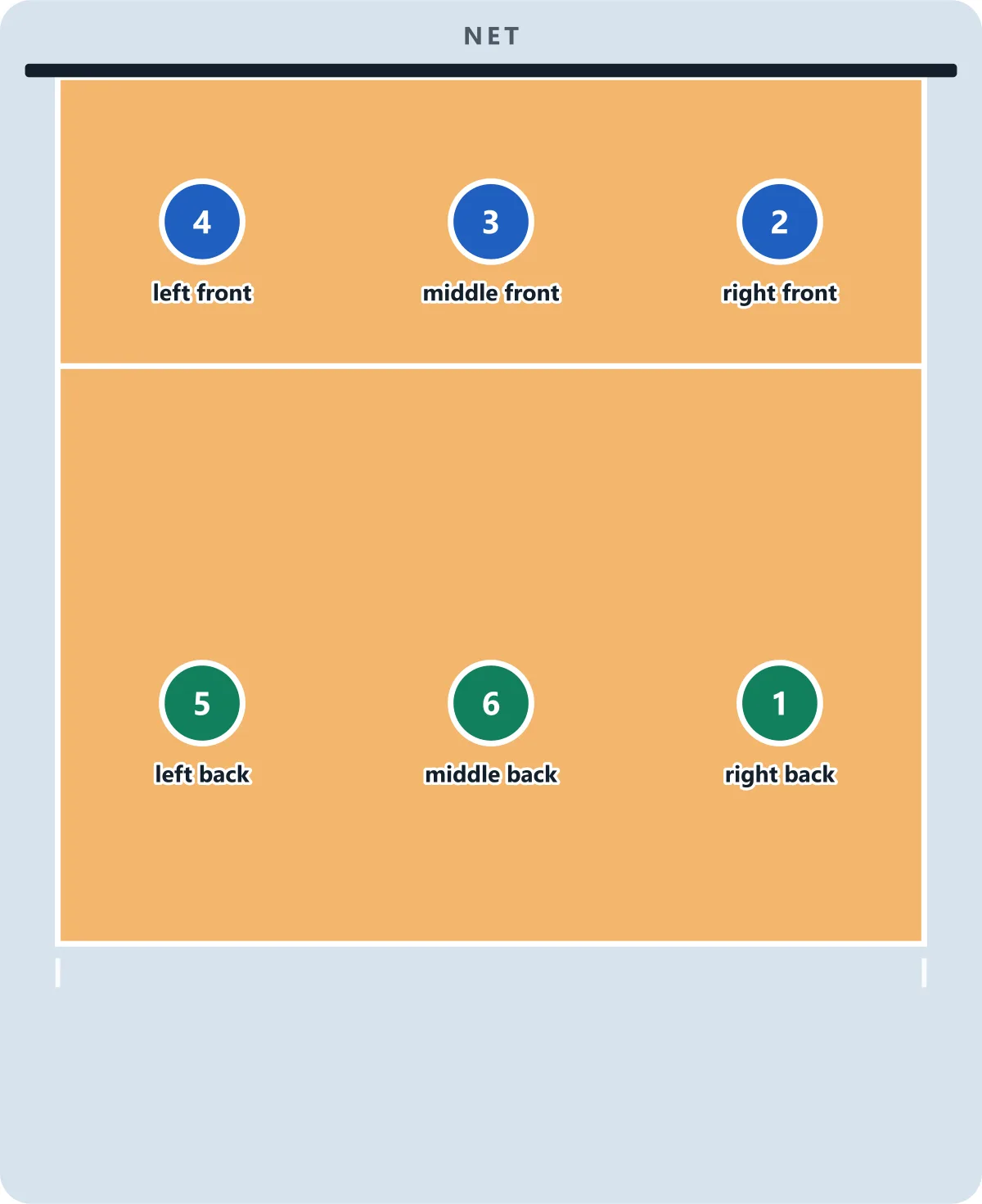
Four blank downloads are above: a court with zones 1-6, a blank 6-rotation grid, a half court for drawing plays, and a full court with both sides of the net.
Blank vs filled volleyball rotation sheets
| Filled sheet | Blank sheet | |
|---|---|---|
| Best for | Match day, the clipboard | Planning, teaching, quick changes |
| Accuracy | Built and overlap-checked by the engine | Depends on your pencil |
| Shows | Names, numbers, setter, libero, attackers | Zones and empty circles |
| Changes | Reprint in seconds | Erase and rewrite |
Rotation sheets for players
Players learn faster from their own spot than from the whole team. Two printouts help:
- Player cards: one card per player showing “where I stand” in all six rotations, with her dot circled. Four cards fit on a page with cut lines. Hand them out the week before a match.
- Wall chart: a poster of all six rotations for the locker room or the gym wall, on one page or across four pages taped together.
Both print from the generator with your team’s names, along with a rotation book (one rotation per page) for team meetings.
Filling in a blank rotation sheet by hand
- Write your starting six in zone order for Rotation 1: zone 1 (right back) first, then 2, 3, 4, 5, 6.
- For Rotation 2, move every number one zone clockwise: the zone 2 number goes to zone 1, zone 1 to zone 6, and so on.
- Repeat for Rotations 3 to 6. Rotation 6 rotated once more must give you Rotation 1 again; if not, find the mistake.
- Circle your setter and mark the libero in the back row where she replaces the middle.
Rotation sheet volleyball tips
- One page. All six rotations should fit on one page so you never flip.
- Big numbers. Jersey numbers must be readable from a meter away in a dark gym.
- Mark the setter and libero. Our sheets use a ring for the setter and a square badge for the libero.
- Note the weak rotation. With two front-row attackers and a weak passer, plan a play or a serving target there.
- Laminate it or put it in a sheet protector; gyms are sweaty.
For systems with their own sheets, see the 5-1 rotation and 6-2 rotation cheat sheets. To hand the officials the matching order, print the volleyball lineup sheet from the same lineup. For full control, open the volleyball rotation generator.
Frequently asked questions
How do you use a volleyball rotation chart?
Find the rotation your team is in (most sheets number them by the setter's zone), then check each player's spot before the serve. Between rallies, look one rotation ahead so you can remind the next server and the libero. In practice, point players to their circle on the sheet until they know every rotation without it.
What is a volleyball rotation sheet?
It is a one-page plan of your six rotations. Each small court shows where every player stands at the serve, usually in serve receive, sometimes with arrows to base defense. Coaches use it on the bench and in practice; players use it to learn where they stand. It is different from the lineup sheet you give the officials.
What should be on a rotation sheet?
Six courts labeled Rotation 1 to 6, each player's jersey number and name in the right spot, the setter marked, and the libero shown in her back-row spot. Helpful extras are arrows to base defense, the number of front-row attackers, and who passes. Add the team name, system and date at the top.
Should I use a blank or a filled rotation sheet?
Use a filled sheet when your lineup is set: it is faster to read and has no handwriting mistakes. Use a blank sheet when you are planning, teaching rotations to kids, or changing lineups often. Many coaches keep both on the clipboard: the filled sheet for the match and a blank one for notes.
How do I make a volleyball rotation sheet?
Type your six starters in serving order and your libero into the maker above, pick your system, and download the PDF. For drag-and-drop changes, base defense and overlap checking, use the full rotation generator, which prints the same sheet plus player cards, a wall chart and a lineup sheet.
Is the rotation sheet the same as the lineup sheet?
No. The lineup sheet is the official form you give the scorer or referee before each set: the six starters in serving order, liberos and captain. The rotation sheet is your own plan of where everyone stands in each rotation. Make the lineup sheet from the same lineup so the two always match.
Rules checked
Rule sets used on this page: NFHS (high school) 2026-27, USAV (club) 2025-27, NCAA (college) 2026 and FIVB (international) 2025-28. Where leagues differ, the tool makes it a setting. Always check your league or state association.
- Overlap: when judged: USAV 7.4.4, 7.5.1
- Overlap: which pairs: USAV 7.4.2-7.4.3; NFHS 6-4-3
Last reviewed: by EmproIT. See how we check the rules.