Quick answer
At the moment the ball is served, each front-row player must be closer to the net than the back-row player behind her, and players in the same row must stay in left-to-right order. Only 7 pairs are compared. The server is exempt, and after the serve everyone can move anywhere.
Volleyball rotation rules in plain English
Five rules cover almost everything:
- Serve in order. The lineup sheet sets the serving order for the whole set.
- Rotate after a side-out. When your team wins the serve back, every player moves one spot clockwise, and the player from zone 2 serves.
- Stand in order at the serve. At the moment the server hits the ball, players must be in their rotation order. That is the overlap rule.
- The server is free. She is not part of the overlap rule.
- After the serve, move anywhere. Switching to your best position is legal once the ball is served.
The rest of this page explains rule 3, because it is the one coaches and parents misunderstand most. Rules 1 and 2 are explained with an animated court on volleyball rotations explained.
Rules for volleyball rotation: the 7 overlap pairs
The rules compare exactly 7 pairs of players. Three pairs are front to back and four are side by side:
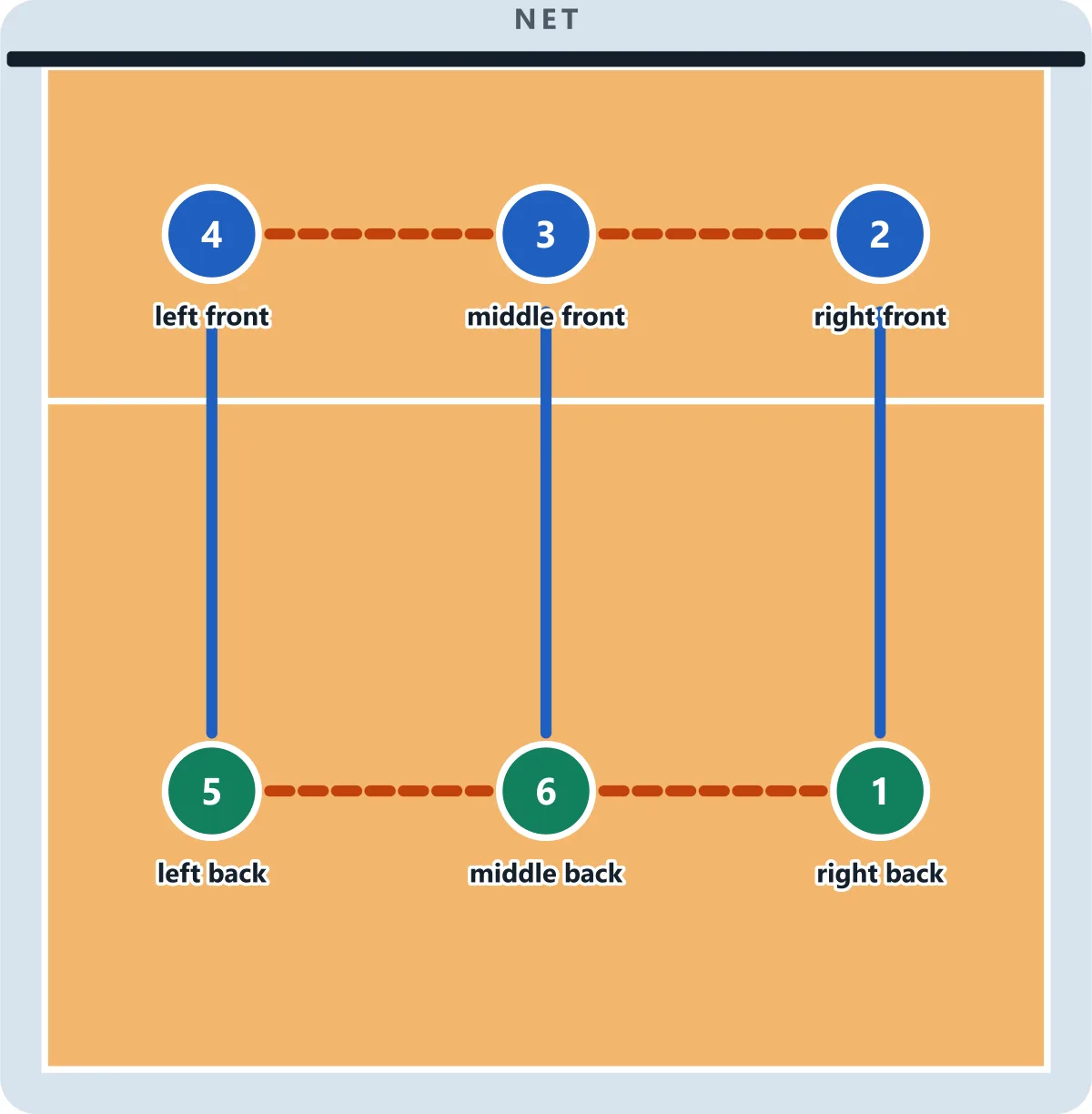
Front vs back (who is closer to the net):
- Zone 4 (left front) must be closer to the net than zone 5 (left back).
- Zone 3 (middle front) must be closer to the net than zone 6 (middle back).
- Zone 2 (right front) must be closer to the net than zone 1 (right back).
Side by side (left to right in each row):
- Zone 4 must be closer to the left sideline than zone 3.
- Zone 2 must be closer to the right sideline than zone 3.
- Zone 5 must be closer to the left sideline than zone 6.
- Zone 1 must be closer to the right sideline than zone 6.
That is all. Only neighbours are compared: left front is never compared with right front, left back is never compared with right back, and no player is compared on a diagonal. A front-row player does not have to be in front of every back-row player, only the one directly behind her. That is why a setter can “hide” right behind a passer, and why the middle back can stand 2 m from the net as long as the middle front is closer.
“Closer” means strictly closer. Standing exactly level is not closer, so the checker treats it as a fault and warns you when a pair is within about 12 inches.
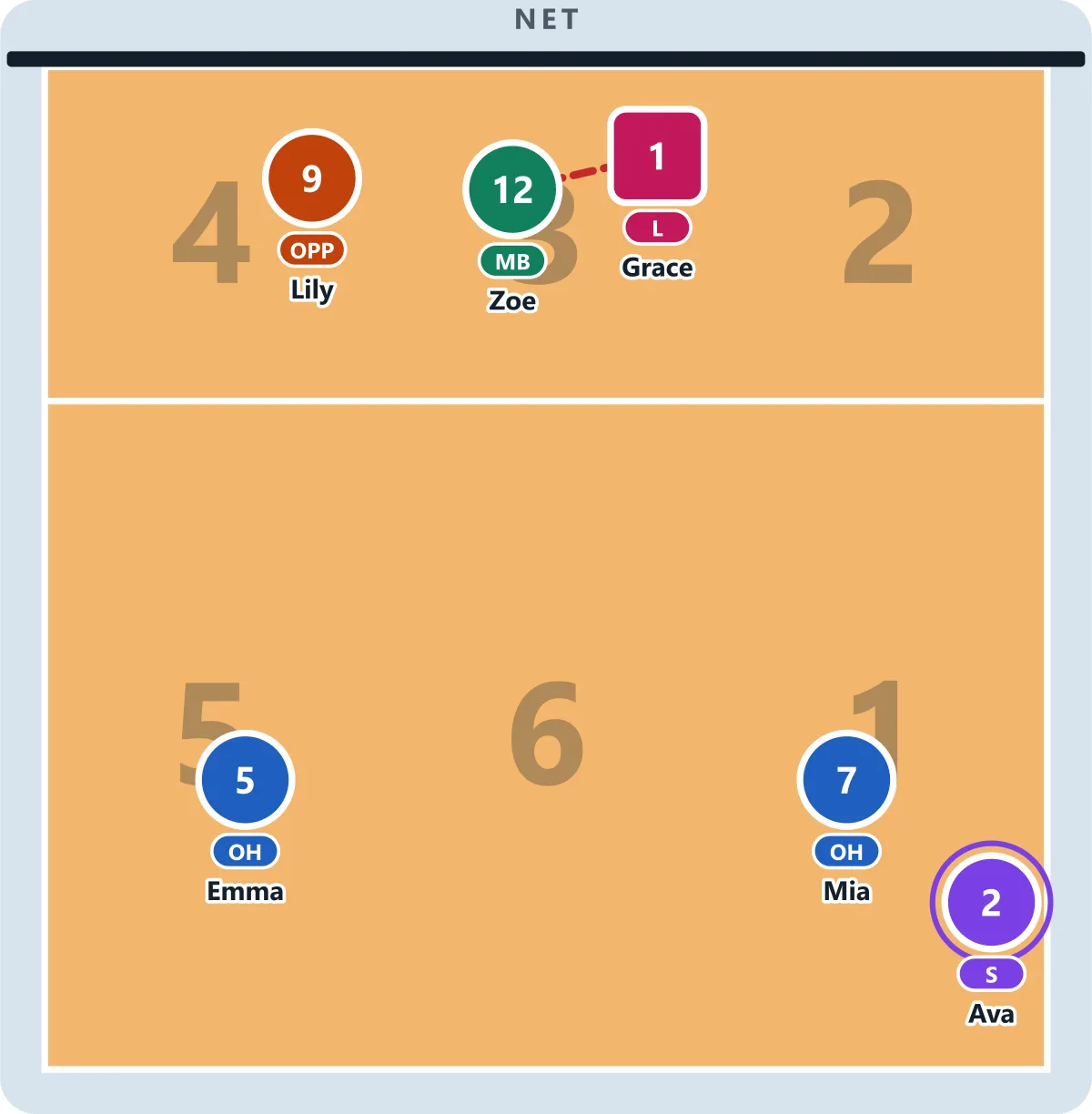
When it is judged: the serve, the server and the feet
- When: at the moment the server contacts the ball. Before that, players may move around; after it, they may go anywhere.
- The server: exempt from the overlap rule in every rule set. For the serving team, the pairs with zone 1 are not checked.
- Feet: USA Volleyball judges by the feet in contact with the floor: part of one foot must be closer to the center line (front vs back) or to the sideline (side by side) than the feet of the partner. NFHS wording says “closer to the center line or sideline” and is judged by the feet in practice; check your state association for the exact wording.
Our tools treat each player as one point (where her feet are) and compare those points, with an amber warning when a pair is closer than about 12 inches.
Serving team vs receiving team
This is where rule sets now differ:
- NFHS (US high school): both teams are checked.
- USA Volleyball (club): both teams are checked (a domestic modification).
- NCAA (college): both teams are checked; we found no change in the 2026 rules, but check the full book.
- FIVB (international) 2025-28: the serving team is not checked for overlap at all. Only the receiving team is.
The receiving team is checked under every rule set. In the checker above, switch between “Receiving team” and “Serving team” and between NFHS and FIVB to see the difference.
Penalties
An overlap gives the rally to the other team:
- NFHS: illegal alignment, loss of rally and point.
- USAV, NCAA and FIVB: positional fault, point and serve to the opponent.
Under NFHS, a libero who replaces a player illegally after the serve is also judged as illegal alignment (new in 2025-26); before the serve it is an unnecessary delay.
Rotation in volleyball rules: serving out of order
Serving with the wrong player is a rotation fault. The other team gets a point and the serve, and your order is corrected. Under USA Volleyball rules, points your team scored while out of order are cancelled if the mistake is found in time. Because the lineup sheet fixes the serving order, a wrong lineup sheet can lock you into a mistake for the whole set, so fill it carefully. See the volleyball lineup sheet guide.
The libero has extra serving rules: she may serve in one rotation per set under NFHS, USAV and NCAA rules, and not at all under FIVB rules (check your event). Serving in a second rotation is a rotational fault under USAV rules. See libero rotation rules.
Rotation rules for volleyball by rule set
| Rule | NFHS 2026-27 | USAV 2025-27 | NCAA 2026 | FIVB 2025-28 |
|---|---|---|---|---|
| Overlap pairs checked | 7 pairs | 7 pairs | 7 pairs | 7 pairs |
| Serving team checked | Yes | Yes | Yes (check full book) | No |
| Server exempt | Yes | Yes | Yes | Yes |
| Overlap penalty | Loss of rally | Point + serve | Point + serve | Point + serve |
| Libero may serve | One rotation per set | One rotation per set | One rotation per set | No (check) |
| Substitutions per set | 18 (check) | 15 | 15 (D-I), 18 (D-II, D-III) | 6 (check) |
“Check” means rule bodies differ or we could not confirm the exact wording: confirm with your league or state association. Substitution details are on the substitution rules page.
Common overlap mistakes
- Thinking every pair counts. Only neighbours do. Left front can be anywhere relative to right front, and diagonals are never compared.
- Lining up in neat rows. A legal formation can look messy. Serve receive often puts a front-row player 6 m from the net.
- Hiding the setter too far. The setter only needs to be behind her one front-row partner, not behind everyone.
- Switching early. Players who move before the serve contact can create an overlap. Teach “serve, then switch”.
Every formation in our tools, including the serve receive formations, passes this checker for the rule set you choose. Build yours in the volleyball rotation generator.
Frequently asked questions
What are the rotation rules in volleyball?
Players serve in the order on the lineup sheet for the whole set, and the team rotates one spot clockwise after every side-out. At the moment of the serve, players must be in their rotation order: front-row players closer to the net than their back-row partners, and players in each row in left-to-right order. After the serve they may move anywhere.
What is overlapping in volleyball?
An overlap is when two players who are compared by the rules are out of order at the moment of the serve. For example, the middle back stands closer to the net than the middle front, or the left front stands to the right of the middle front. Only 7 pairs are compared. Players who are not next to each other, like left front and right front, are never compared, and neither are players on a diagonal.
What does out of rotation mean in volleyball?
It usually means one of two faults. Either the wrong player served (a serving order fault), or players were out of position at the serve (an overlap). Both give the other team a point and the serve. Officials and coaches also say "out of rotation" when a team is in the right order but a player forgot where to stand.
What is a rotational fault in volleyball?
A rotational fault happens when a team serves out of its serving order. The other team gets a point and the serve, and the order is corrected. Under USA Volleyball rules, points the faulting team scored while out of order are also cancelled if the mistake is found in time. Under USAV rules a libero serving in a second rotation is also a rotational fault.
Are points given after each fault in volleyball?
Yes. Volleyball uses rally scoring, so every rally ends with a point for one team. If your team commits a fault, such as an overlap or serving out of order, the other team wins the rally: it gets the point and the serve. If it was receiving, it also rotates before serving.
What is a foot fault in volleyball?
Most often it means a serving foot fault: the server steps on the end line or into the court before she hits the serve, so the serve is a fault and the other team scores. Footwork under the net at the center line has its own rules, which differ between rule sets and have changed recently in some, so check your rulebook.
Is the server part of the overlap rule?
No. The server is exempt in every rule set. She may stand anywhere behind the end line, and the pairs that include zone 1 (2 with 1, and 6 with 1) are not checked for the serving team. The receiving team's zone 1 player is checked, because she is not serving.
Does the serving team have to follow the overlap rule?
Under NFHS, USA Volleyball and NCAA rules, yes: the serving team is checked too, except for the server. Under the FIVB 2025-28 rules, the serving team is no longer checked for overlap at all. The receiving team is checked under every rule set. Our tools follow the rule set you pick.
Rules checked
Rule sets used on this page: NFHS (high school) 2026-27, USAV (club) 2025-27, NCAA (college) 2026 and FIVB (international) 2025-28. Where leagues differ, the tool makes it a setting. Always check your league or state association.
- Overlap: which pairs: USAV 7.4.2-7.4.3; NFHS 6-4-3
- Rotation direction / when: USAV 7.6.2
- Overlap: serving team checked? FIVB 2025-28 Rule 7.4 (differs by league — check yours)
- Overlap penalty: NFHS 6-4 Penalties
- Libero: serving: USAV 7.7.1; NCAA 2024 (differs by league — check yours)
- Substitution limit per set: USAV 15.1, 15.6; NCAA 2026 (differs by league — check yours)
Last reviewed: by EmproIT. See how we check the rules.