Quick answer
Each team may make a limited number of substitutions per set: 18 under NFHS (check your state), 15 under USA Volleyball and NCAA Division I, 18 in NCAA Divisions II and III, and 6 under FIVB (check your event). A player who re-enters goes back to her own lineup spot (USA Volleyball and FIVB say so; check the wording for your league). Libero replacements are not substitutions.
Volleyball rules for substitution by rule set
| Rule set | Subs per team per set | Re-entry |
|---|---|---|
| NFHS 2026-27 (high school) | 18 (check your state) | Allowed within the limit (check wording) |
| USA Volleyball 2025-27 (club) | 15 (was 12); some events use a 6-sub format | Any number of times within 15, always the same lineup spot |
| NCAA 2026 Division I | 15 | Within the limit |
| NCAA 2026 Divisions II and III | 18 | Within the limit |
| FIVB 2025-28 | 6 (check your event) | A starter may leave once and return once, to her own spot |
| Rec / youth leagues | Set by the league | Set by the league |
“Check” marks values that differ between leagues or that we could not confirm word for word. Your state association or league has the final say.
Re-entry: back to the same spot
The most important substitution rule: a player always re-enters in the same lineup spot. If Nora subs in for Zoe in spot III, then Zoe can only come back in spot III, for whoever is in it. Under USA Volleyball rules this is explicit: any number of times within the limit, always the same spot. Under FIVB rules a starter may leave once and come back once, to her own spot.
Keeping players in their spots protects the serving order on the lineup sheet. That is why subs never change who serves next, and why the generator and scoreboard track every player’s spot.
The libero is not a sub
Libero replacements do not count as substitutions. The libero may only leave for the player she replaced, and under NFHS rules there must be at least one completed rally between libero replacements. A defensive specialist (DS), on the other hand, is a regular player: every time she enters, it counts against your limit. See libero rotation for the full libero rules.
Setter and opposite subs in a 6-2
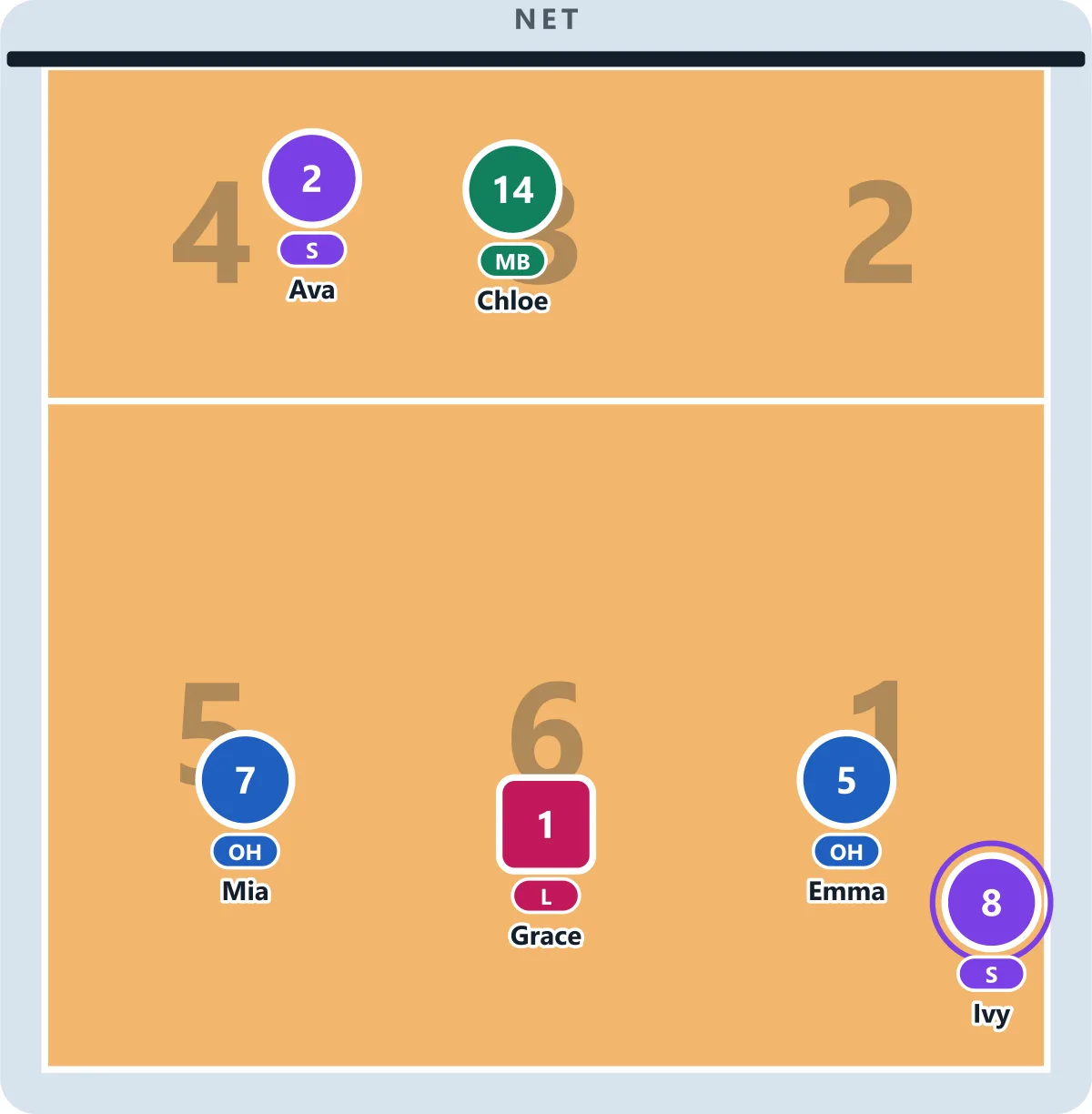
Teams running a 6-2 often sub a hitter in for the front-row setter and bring the setter back when her spot reaches zone 1. That is four subs per full trip through the six rotations. With 18 subs you can do it four times per set (16 subs); with 15, three times (12 subs). Under FIVB rules (6 subs, and a starter may leave and come back only once) it fits only once per set; check your event.
Youth sub strategies
Youth and rec coaches have a different goal: fair playing time. Three approaches:
- Planned subs at set scores. Split each set into chunks (for example at 8 and 16 points) and rotate bench players in by a plan. The playing-time balancer above builds the plan for 7 to 14 players and prints it.
- Sub through rotation. Some rec leagues bring a bench player in at a fixed spot (often zone 1, so she serves) on every rotation, and the player leaving goes to the end of the line. It is a league rule; check yours. The volleyball scoreboard can run it automatically.
- Rotate by set. Simple but less fair: different starters each set.
Whatever you choose, keep the re-entry rule in mind: a returning player goes back to her own spot. The balancer marks any planned sub that would put a player in a new spot.
Plan your subs before the match
Most sub problems start on the bench, not on the court. A few minutes of planning helps:
- Write sub pairs. For each lineup spot, write who can come in for whom: “Nora for Zoe (spot III)”, “Lily for Ava (spot I)”. Bench players then know their spot.
- Budget your limit. Count the subs your plan uses per set. A 6-2 setter swap plus two DS entries per trip around the rotation can use 8 subs or more.
- Keep two spare. Leave room for an injury or a serving specialist late in the set.
- Tell the scorer and the second referee. Clear, early requests prevent delays and wrong-spot errors.
| Example plan (NFHS, 18 subs) | Subs used |
|---|---|
| 6-2 setter-opposite swaps, 3 trips | 12 |
| DS for a back-row outside, twice | 4 |
| Spare | 2 |
Using the sub counter
- Pick your rule set (and NCAA division). The limit appears.
- Tap Sub each time your team or the opponent makes one. Add jersey numbers if you like.
- The counter turns amber at two subs left and stops at the limit.
- If your league allows more, tap “My league allows more” to keep counting.
- Tap Next set to reset both teams.
The counter saves on this device, so a refresh does not lose your count. For full tracking with rotation, server and libero, use match mode in the volleyball scoreboard.
Substitutions and the lineup sheet
The lineup sheet fixes your starting six and serving order for the set. Under USA Volleyball rules, once it is handed in, changes can only be made with regular substitutions. That is why a mistake on the sheet is costly: fixing it can use subs. Read about overlap and serving-order faults on the rotation rules page.
Frequently asked questions
How many substitutions are allowed in volleyball?
It depends on the rule set: 18 per team per set under NFHS (check your state), 15 under USA Volleyball (raised from 12 for 2025-27), 15 in NCAA Division I and 18 in Divisions II and III from 2026, and 6 under FIVB rules. Rec and youth leagues set their own limits. The counter on this page uses the right limit for each.
How many subs do you get in volleyball per set?
The limit is per set and resets at the start of the next set. Under NFHS rules it is 18 (check your state), under USA Volleyball 15, in NCAA Division I 15, in Divisions II and III 18, and under FIVB 6 (check your event). Each player who enters counts as one substitution, and libero replacements do not count at all.
How do substitutions work in volleyball?
The coach requests a sub while the ball is dead. The new player enters the same lineup spot as the player leaving, so the serving order does not change. If the starter comes back later, she returns to that same spot (USA Volleyball and FIVB say so; check the wording for your league). The scorer counts every sub against your limit for the set.
When can you sub in volleyball?
Only when the ball is dead, between rallies and before the next serve. Your league's rules say who may request it and how, for example the coach or the captain, and whether you can make several subs at once. Subs made in a hurry cause most lineup errors, so plan them before the set.
What is an illegal substitution in volleyball?
A sub that breaks the rules: for example, going over the sub limit, a player re-entering into a different lineup spot, or a player entering who is not on the roster or lineup. The penalty depends on your rule set, so check your rulebook. The counter and match mode on this site warn you before you reach your limit.
How many players are on a volleyball team including subs?
Six players are on the court for each team, plus up to two liberos named on the lineup sheet (one on the court at a time). Rosters with substitutes are usually larger, often 10 to 15 players for school and club teams, but the maximum comes from your league or event.
Is the libero a substitution?
No. Libero replacements are a separate kind of change and do not count toward your sub limit. The libero may only leave for the player she replaced, and under NFHS rules there must be one completed rally between libero replacements. A defensive specialist, by contrast, uses a regular substitution every time she enters.
Rules checked
Rule sets used on this page: NFHS (high school) 2026-27, USAV (club) 2025-27, NCAA (college) 2026 and FIVB (international) 2025-28. Where leagues differ, the tool makes it a setting. Always check your league or state association.
- Substitution limit per set: USAV 15.1, 15.6; NCAA 2026 (differs by league — check yours)
- Substitution: re-entry: USAV 15.6d (differs by league — check yours)
- Libero: replacements: WHSAA libero sheet
- Lineup sheet: NFHS 6-4-2, 5-6-1c; USAV 7.3.2-7.3.4
- Youth: sub through rotation: Rogers AR rules
Last reviewed: by EmproIT. See how we check the rules.