Quick answer
The libero is a back-row specialist who replaces any back-row player, most often both middle blockers. She comes in when that player is in the back row and must leave for the same player before she reaches the front row. Her replacements are not substitutions. She may serve in one rotation per set under NFHS, USAV and NCAA rules.
What a libero does
The libero is your back-row defense and serve receive specialist. She passes serves, digs attacks and covers. She plays only in the back row and wears a jersey that stands out from her teammates. Most teams put their best passer at libero and give her the middle lane in serve receive. For how she fits with the other roles, see volleyball positions.
Volleyball position libero: who she replaces
Under every rule set, the libero may replace any back-row player. Most teams use her for both middle blockers, for two reasons:
- Middles are usually tall and great at the net but weaker passers.
- The two middles are across from each other in the lineup, so exactly one of them is always in the back row. One libero covers both.
In our sample 5-1 team, Grace (#1) replaces Zoe (#12) and Chloe (#14). Some coaches use the libero for an outside hitter or for the setter in certain rotations; the full generator’s “Libero replaces” setting lets you try any choice.
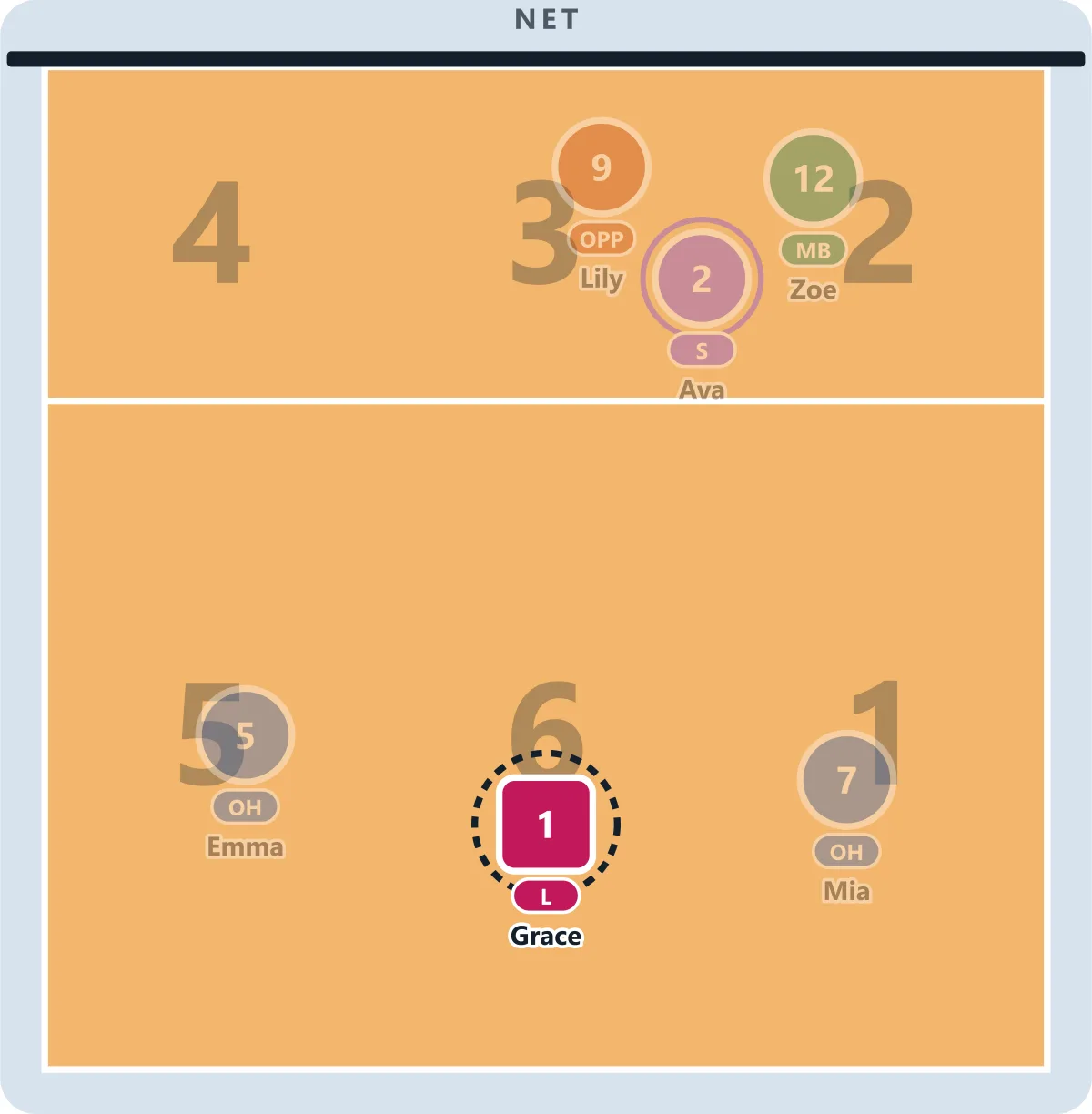
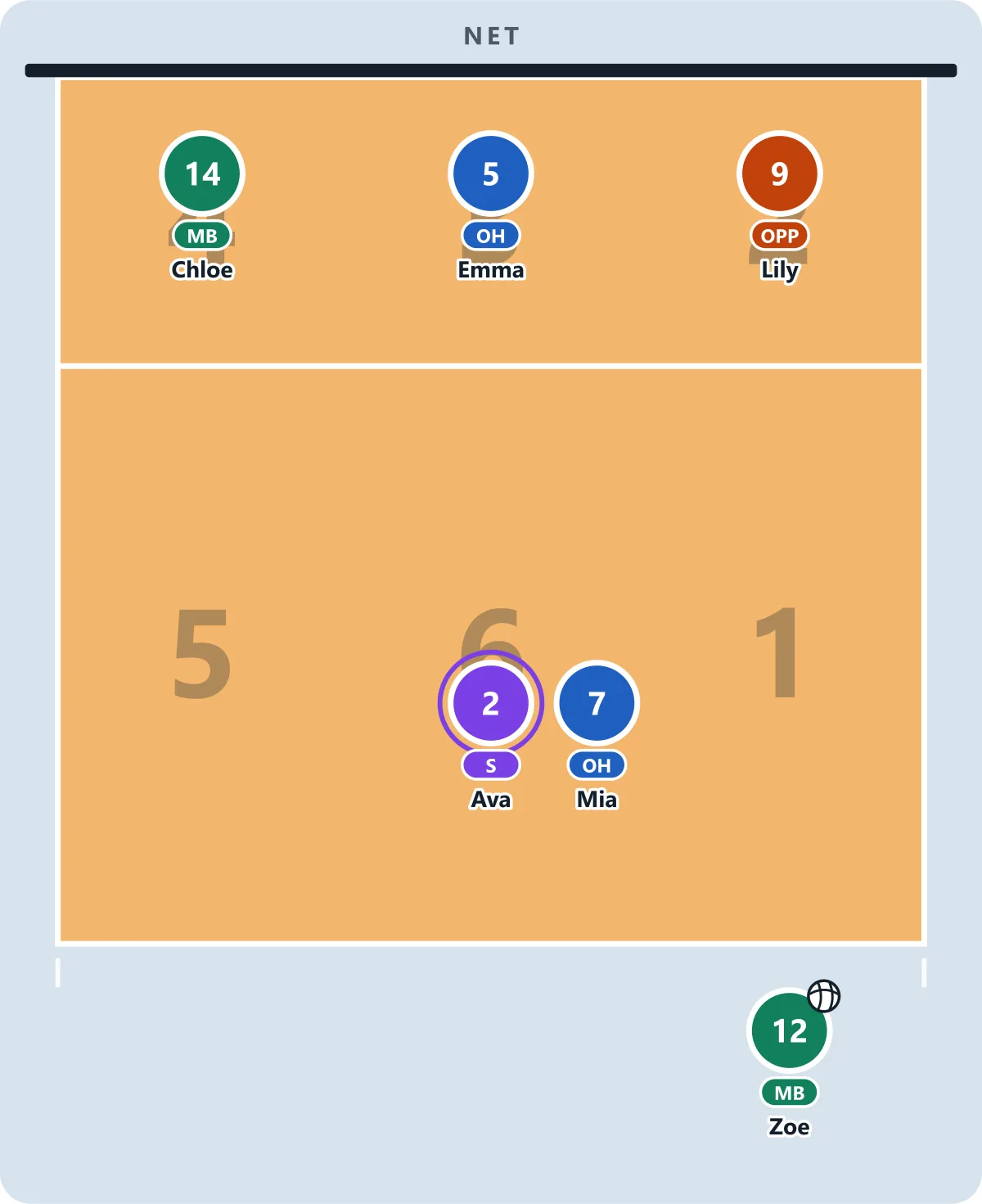
Entering and leaving: the libero rotation
The pattern for a libero who replaces both middles:
- Middle rotates to the back row. When a middle reaches zone 1 by rotating, she is the server. Unless it is the libero’s serving rotation, the middle serves.
- The team loses the serve. Now the libero comes in for that middle, before the next serve.
- She plays zones 1, 6 and 5 as the team rotates.
- Before zone 4. When the libero’s spot would rotate into the front row, she must leave, and the same middle she replaced comes back in. Meanwhile the other middle has reached the back row, and the cycle starts again.
Rules for every replacement:
- She leaves only for the player she replaced.
- Libero replacements are not substitutions: they do not count toward your sub limit.
- Under NFHS rules there must be at least one completed rally between libero replacements.
- Under NFHS rules, an illegal libero replacement found before the serve is an unnecessary delay; found after the serve, it is illegal alignment (2025-26 change).
Where the libero plays in base defense
After the serve, the libero switches to her defensive spot like everyone else. Most teams put her in middle back in a perimeter defense, so she can read the hitter and cover deep shots. Some coaches prefer her in left back, because most attacks in high school and club volleyball come from the other team’s left side and land cross-court. Try both in the generator settings (“Libero in base defense”) and watch the base view change.
The libero in a 6-2 and 4-2
The libero works the same way in every system. In a 6-2 she usually replaces both middles, just like in a 5-1, and her free replacements are welcome because the setter swaps already use many substitutions. In a 4-2, youth teams often play without a libero at first; when they add one, she again replaces the middles and becomes one of the four passers. In a 6-6, most coaches skip the libero so every player plays every spot.
Libero can serve: the rules by rule set
| Rule set | Can the libero serve? |
|---|---|
| NFHS 2026-27 | Yes, in one rotation per set, even with two liberos |
| USAV 2025-27 | Yes, in one rotation per set; a second rotation is a rotational fault |
| NCAA 2026 | Yes, in one rotation per set |
| FIVB 2025-28 | No (check your event) |
The serving rotation is one where a player she replaces is the server (zone 1). In the visualizer above, pick “Libero serves” to see it.
Two liberos (NFHS 2026-27)
New for 2026-27, NFHS teams may name 0, 1 or 2 liberos per set on the lineup sheet, but only one may be on the court at a time. The libero serving rule does not change: still one serving rotation per set, even with two liberos. USA Volleyball also allows two (a team that starts with two keeps two for the match), NCAA allows two per set with one on the court, and FIVB allows up to two.
A common way to use two liberos: Libero 1 plays serve receive, Libero 2 plays defense when your team serves. The generator supports this (“Libero 1 receives, Libero 2 when serving”) and only ever puts one libero on the court.
Volleyball libero rules: libero vs DS
| Libero | Defensive specialist (DS) | |
|---|---|---|
| Uses a substitution | No | Yes |
| Plays | Back row only | Back row (rotates like anyone) |
| Jersey | Different from teammates | Same as teammates |
| Serving | One rotation per set (NFHS, USAV, NCAA) | Normal serving |
| Leaves for | The player she replaced | Normal re-entry rules |
A DS is useful when your libero is already on the court for the middles and you want a better passer in for a back-row outside or opposite. Every DS entry uses a sub, so check your substitution limit.
The libero tracker
Libero mistakes are easy to make in a fast match: coming in for the wrong player, staying on into the front row, or serving in a second rotation. A tracker on the scorer’s table prevents them. Each row records the libero number, the player she replaced, and the score when she came in and went out.
Download the blank libero tracker (PDF), or print one filled with your lineup from the volleyball rotation generator. The scoreboard’s match mode also reminds you when the libero is about to rotate to the front row.
Common libero mistakes
- Late exchange. The libero is still on the court when her spot reaches zone 4. Watch zone 5 before every side-out.
- Wrong player back. She must leave for the player she replaced, not for a different middle.
- Second serving rotation. Write the one serving rotation on your clipboard.
- Counting her as a sub. She does not use your subs; a DS does.
For the overlap rules the libero must follow at the serve, see rotation and overlap rules.
Frequently asked questions
What does the libero do in volleyball?
The libero is the team's back-row defense and serve receive specialist. She replaces a back-row player, usually a middle blocker, and passes, digs and covers. She plays only in the back row, wears a different jersey, and her replacements do not use up substitutions. Most teams give her the most court in serve receive.
Can a libero serve?
Under NFHS, USA Volleyball and NCAA rules, yes, but in only one rotation per set. Even with two liberos, NFHS allows just one serving rotation. Under USAV rules, a libero serving in a second rotation is a rotational fault. Under FIVB rules the libero may not serve (check your event). Pick her serving rotation before the set and write it on your rotation sheet.
Why is there a libero in volleyball?
The libero lets a team put its best passer and defender on the court for most of the match without using substitutions. Tall middle blockers can stay at the net for the front-row rotations while the libero handles their back-row rotations. That keeps rallies longer and makes serve receive stronger.
Who does the libero replace?
Any back-row player. Most teams use her for both middle blockers, because middles are usually the weakest passers. Some teams use her for an outside hitter or the setter in certain rotations instead. She must come out for the same player she replaced, and she can never play in the front row.
Is a libero replacement a substitution?
No. Libero replacements do not count toward your team's substitution limit, and the scorer tracks them separately. The libero must leave for the same player she replaced. Under NFHS rules there must be at least one completed rally between libero replacements. That is why many scorers keep a separate libero tracker.
How many liberos can a team have?
Under the NFHS 2026-27 rules a team may name 0, 1 or 2 liberos for each set on the lineup sheet, with only one on the court at a time. USA Volleyball also allows two, and a team that starts with two keeps two for the match. NCAA allows two per set, one on the court. FIVB allows up to two.
What is the difference between a libero and a defensive specialist?
A defensive specialist (DS) is a regular player who subs in for back-row defense, so every DS entry uses a substitution, and she may serve normally. The libero has special rules: her replacements are free, she plays only the back row, she wears a different jersey, and she may serve in one rotation at most.
Rules checked
Rule sets used on this page: NFHS (high school) 2026-27, USAV (club) 2025-27, NCAA (college) 2026 and FIVB (international) 2025-28. Where leagues differ, the tool makes it a setting. Always check your league or state association.
- Libero: where: NFHS 10-4-1a
- Libero: replacements: WHSAA libero sheet
- Libero: serving: USAV 7.7.1; NCAA 2024 (differs by league — check yours)
- Libero: how many: NFHS 6-4-2, 10-4-3 (2026-27)
- Lineup sheet: NFHS 6-4-2, 5-6-1c; USAV 7.3.2-7.3.4
Last reviewed: by EmproIT. See how we check the rules.