Quick answer
A volleyball team has six players on the court. The main positions are setter, outside hitter, middle blocker, opposite (right side), libero and defensive specialist. Positions are jobs; zones 1-6 are spots on the court. Players rotate through all six zones but switch to their position's spot after each serve.
All volleyball positions explained
Six players are on the court for each team. Each has a role, and each role has a home spot after the serve:
| Position | Short | Main job | Plays from |
|---|---|---|---|
| Setter | S | Sets the second ball, runs the offense | Right side (zone 2 / zone 1) |
| Outside hitter | OH | Attacks from the left, passes | Left front (4) / left back (5) |
| Middle blocker | MB | Blocks, hits quick sets | Middle front (3) |
| Opposite (right side) | OPP | Attacks from the right, blocks | Right front (2) / right back (1) |
| Libero | L | Passing and defense specialist | Back row only (6 or 5) |
| Defensive specialist | DS | Back-row passing and defense | Back row |
A common lineup is 1 setter, 2 outside hitters, 2 middles and 1 opposite, with the libero replacing the middles in the back row. That is the 5-1 system.
Volleyball setter
The setter is the playmaker. She takes the second contact, which is usually the pass, and delivers a hittable set. A great setter makes average passes look good.
- Job: set the hitters, call plays, dump the ball when the block cheats, and cover after the attack.
- Skills: soft and accurate hands, fast footwork to bad passes, quick decisions, a loud voice.
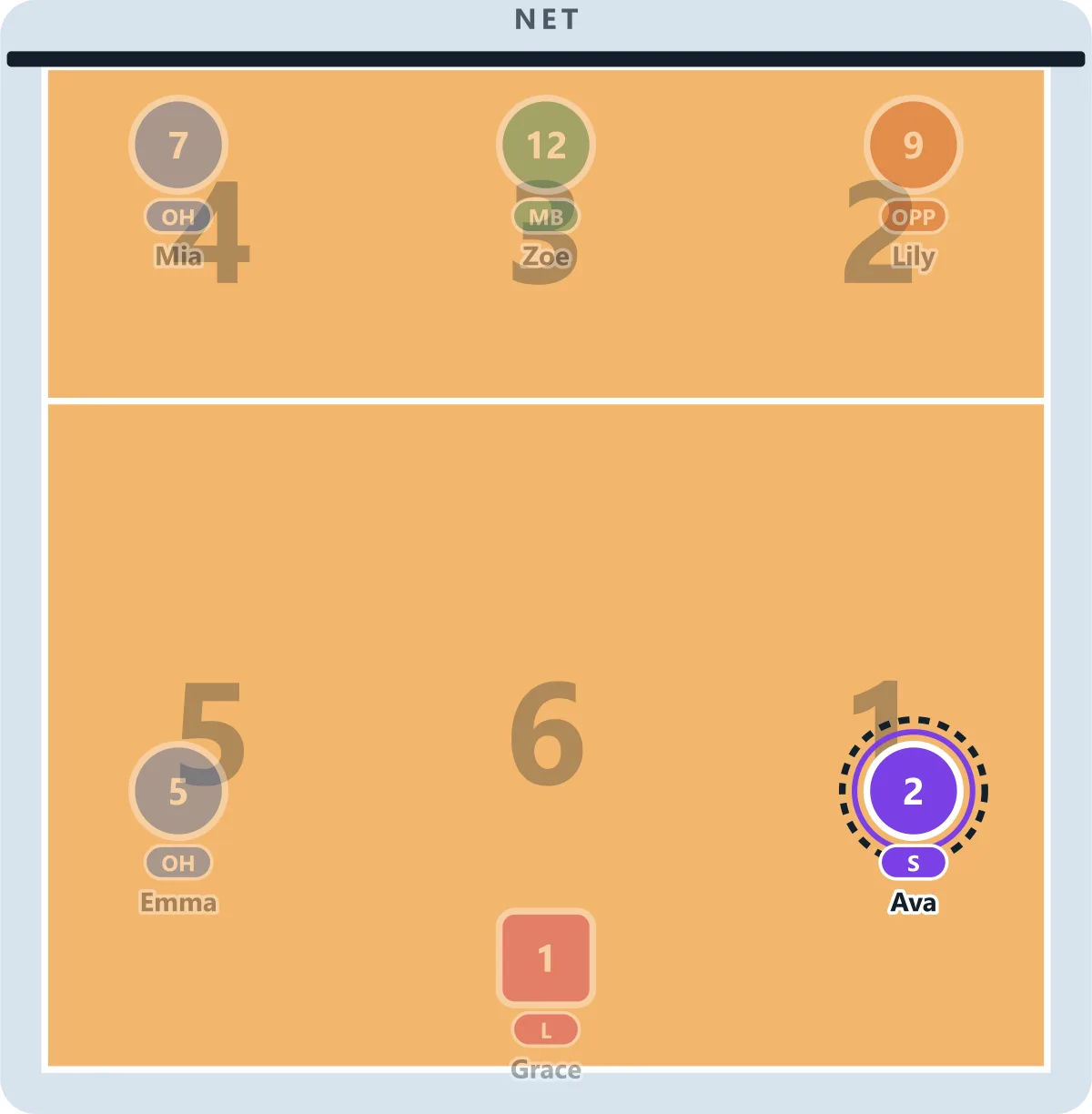
- Where: after the serve, the setter goes to the right side: right-front at the net or right back on defense.
Outside hitter volleyball (OH)
The outside hitter attacks from the left side (zone 4) and is often the go-to hitter. She also passes in serve receive and plays defense, so many outsides are true all-around players.
- Skills: passing, a strong approach, attacking hittable and bad sets, back-row defense.
- Where: left front at the net; left back on defense.
Middle blocker volleyball (MB)
The middle blocker owns the middle of the net. She blocks every hitter on the other side, left, middle and right, and attacks quick sets.
- Skills: height and reach, fast feet along the net, timing with the setter, reading the other setter.
- Where: middle front. In the back row, most teams replace her with the libero.
Opposite hitter volleyball (OPP, right side)
The opposite lines up across from the setter in the lineup, which is where the name comes from. She attacks from the right side and blocks the other team’s outside hitter.
- Skills: strong block, attacking from the right, often a backup setter when the setter digs the first ball.
- Where: right front at the net; right back on defense. Some coaches call her the “right side hitter” or “RS”.
Volleyball position libero
The libero is the back-row specialist. She passes and digs, wears a different jersey, and can replace any back-row player without using a substitution. She cannot play in the front row. See libero rotation for when she comes in and out.
- Skills: the best passer and digger on the team, quick reads, calm leadership.
DS in volleyball (defensive specialist)
A defensive specialist is a back-row player who subs in for passing and defense, often for the opposite or an outside hitter in the back row. Each DS entry is a regular substitution, and the DS may serve. Many teams use a DS who is also a strong server.
Serving specialist
Some teams bring in a player mainly to serve: she subs in when her spot reaches zone 1, serves until the team loses the rally, and subs out. It uses two substitutions each time, so coaches save it for tight moments late in a set. In youth volleyball every player serves, and a reliable serve is the fastest way to earn playing time.
Front row and back row
Positions also depend on the row a player is in at that moment:
- Front-row players (zones 4, 3, 2) block and attack at the net.
- Back-row players (zones 5, 6, 1) pass and dig. They may still attack, but only by jumping from behind the attack line (a “back-row attack”), and they may not block.
That is why the libero, a back-row-only player, replaces the tall middles, and why a setter in the back row sets but does not attack the ball above the net near it.
Volleyball positions by system
The system decides how many of each position you play:
- 5-1: 1 setter, 2 outsides, 2 middles, 1 opposite, plus a libero. The setter sets in every rotation.
- 6-2: 2 setters, 2 outsides, 2 middles. The back-row setter sets; the front-row setter hits like an opposite. See the 6-2 rotation.
- 4-2: 2 setters, 2 outsides, 2 middles. The front-row setter sets, so only two players attack.
- 6-6: no fixed positions. Whoever stands in the setting spot sets, and everyone else hits and passes.
Positions in volleyball are not fixed for life: many high school setters played outside in middle school, and many liberos started as outsides.
Volleyball positions on court: zones and position numbers
The court has six zones, numbered from the serving spot and going counter-clockwise:
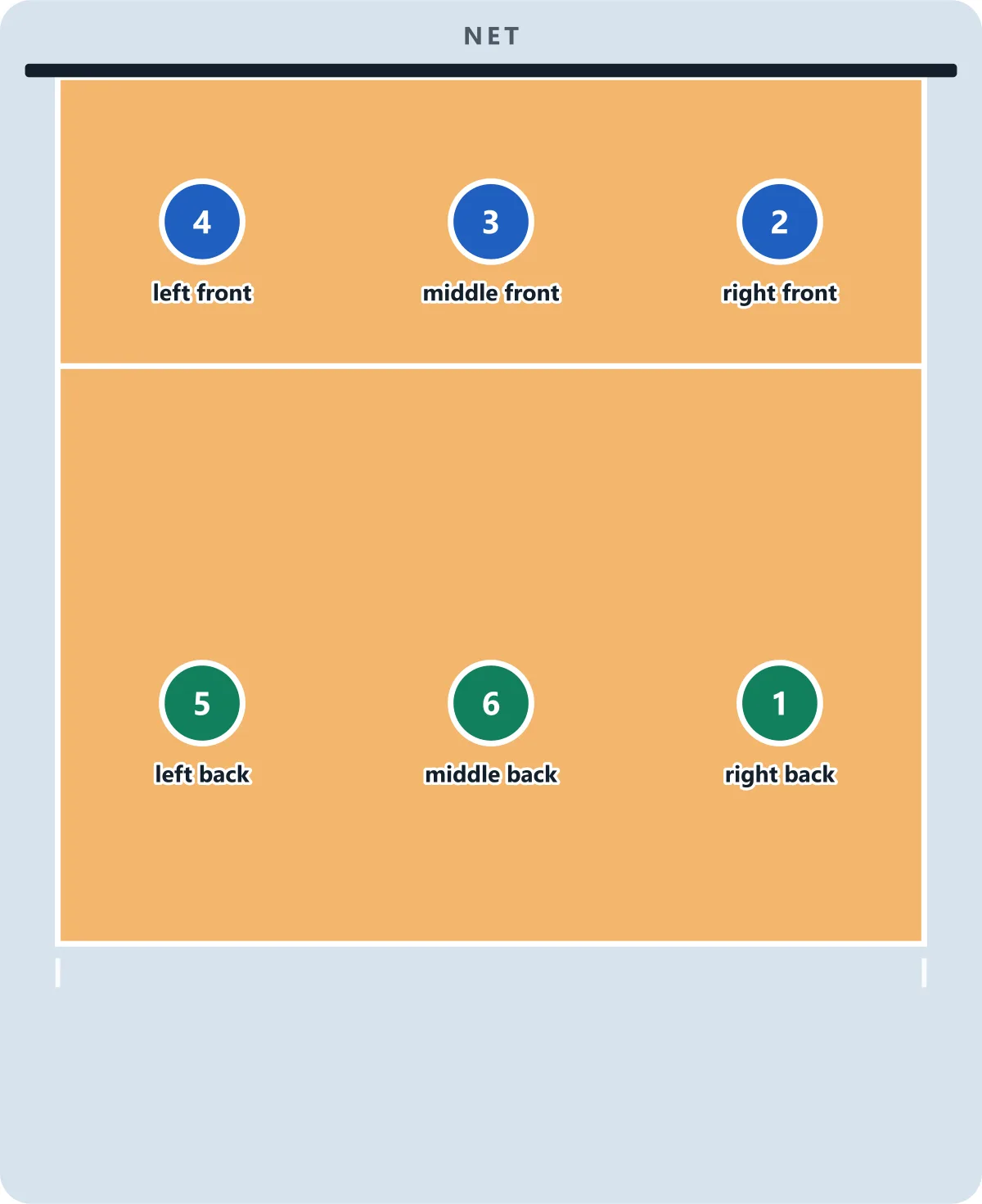
- Zone 1: right back (the server)
- Zone 2: right front
- Zone 3: middle front
- Zone 4: left front
- Zone 5: left back
- Zone 6: middle back
Coaches use these numbers as shorthand: an outside hitter is a “4”, an opposite is a “2”, a set to the middle is a “3”. Do not mix up zones with rotations. A zone is a spot on the court; a rotation is one of the six lineup states. “Zone 1” is always right back, but “Rotation 1” depends on your lineup. The court above lets you tap each zone.
How many players on a volleyball team?
- On the court: six per team, three front row and three back row.
- Liberos: up to two can be named for a set (NFHS 2026-27, USAV, NCAA and FIVB), one on the court at a time.
- Roster: usually 10 to 15 players for school and club teams, but your league sets the maximum.
- Youth: USA Volleyball allows smaller courts for young age groups (16 x 9 m for 10U, 14 x 9 m for 8U-9U) and lower nets. Your league will say which apply.
Volleyball positions and rotations
Every player rotates through all six zones, but she does not play every position. The trick is switching: at the serve, players stand in their rotation order; as soon as the ball is served, they move to their position’s spot. A setter who starts in zone 4 slides to the right side; an outside who starts in zone 2 moves to the left.
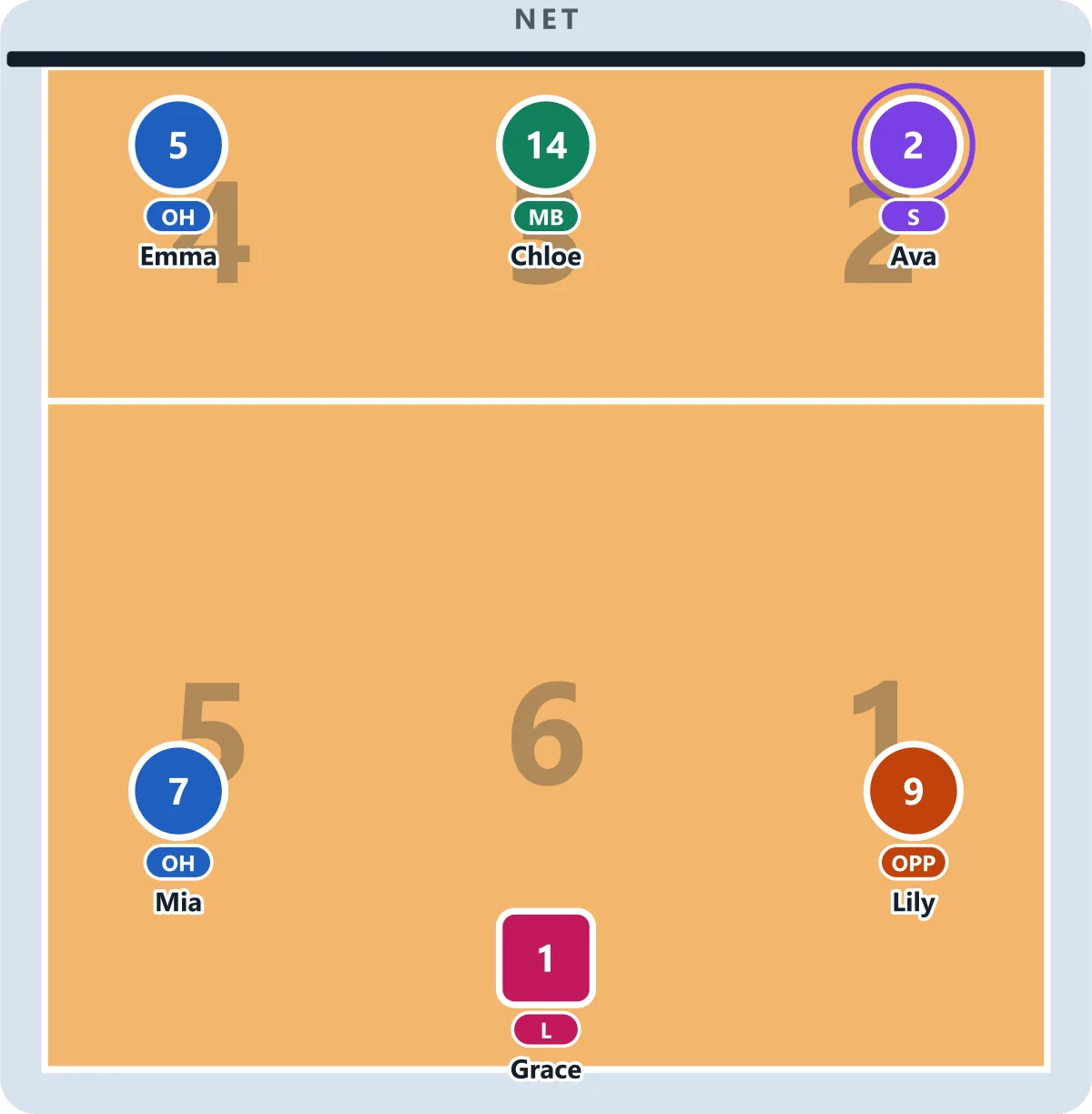
That is legal because the overlap rule only applies at the serve. For how and when teams rotate, see volleyball rotations explained. The volleyball rotation generator shows every player’s serve, receive and base spot in all six rotations.
Volleyball defense positions and the ready position
In base defense most teams use a perimeter setup: blockers at the net, the left and right backs near the sidelines about 6 to 7 m from the net, and the middle back deep. Each player starts in a ready position: feet a bit wider than the shoulders, knees bent, weight forward, arms loose and in front. Passers keep their hands apart until the ball is coming, then join them into a platform.
Positions in youth volleyball
Young players should not be locked into one position too early. Most 8U to 12U teams play a 6-6 or a 4-2, where every player passes, hits and takes turns setting. Coaches who specialize too soon often end up with a 13-year-old middle who cannot pass. A good youth plan:
- Every player learns to pass, serve and set before anyone gets a fixed role.
- Rotate setters during practice, even if one player sets in matches.
- Teach the zone numbers and the clockwise rotation first; positions come after.
Parents often ask why their child “has no position” at 10. That is a good sign: the coach is building complete players.
Choosing a position for your skills
Try every position while you are young, then lean into your strengths:
- Great hands and a loud voice? Setter.
- Tall, quick off the floor, love blocking? Middle blocker.
- Strong passer and attacker who wants the ball? Outside hitter.
- Lefty, tall, strong blocker? Opposite is a natural fit; left-handed hitters attack well from the right side.
- Fast, fearless, great passer? Libero or defensive specialist.
Many players change positions as they grow. The best plan is to become a good passer and server first; every position needs both.
Frequently asked questions
What are the positions in volleyball?
The main positions are setter (S), outside hitter (OH), middle blocker (MB), opposite or right side hitter (OPP), libero (L) and defensive specialist (DS). Some teams also use a serving specialist. Six players are on the court, so a typical lineup is one setter, two outsides, two middles and one opposite, with a libero replacing the middles in the back row.
How many players are on a volleyball team?
Six players per team are on the court at once, three in the front row and three in the back row. A team can also name up to two liberos for a set, with one on the court at a time. Rosters with substitutes are usually bigger, often 10 to 15 players, but your league or event sets the maximum.
What is a DS in volleyball?
DS stands for defensive specialist: a back-row player who comes in to pass, dig and serve. She uses a regular substitution each time she enters, and she may serve normally. That is the main difference from the libero, whose replacements are free but who plays only the back row and may serve in one rotation at most.
What are the 7 positions in volleyball?
Coaches usually list setter, outside hitter, opposite hitter, middle blocker, libero, defensive specialist and serving specialist. The first four are the setter and the three main attacking roles. The last three are back-row specialists who come in for defense, passing or serving. Only six players are on the court at once.
What is a setter in volleyball?
The setter takes the second contact and sets the ball to the hitters, a bit like a point guard in basketball. She decides who attacks, so she needs accurate hands, quick feet and good judgment. In a 5-1 one setter sets every rotation; in a 6-2 two setters share the job; in a 6-6 the player in the setting spot sets.
What is the hardest position in volleyball?
Many coaches say setter, because she touches the second ball every rally, must run to bad passes and makes the offense's decisions. Others say libero, because every serve and hard attack comes her way. The best position for a player is the one that matches her skills, size and personality.
What do the numbers mean in volleyball positions?
The numbers 1 to 6 are zones, not players. Zone 1 is right back (the server), 2 right front, 3 middle front, 4 left front, 5 left back and 6 middle back. Some coaches call outside hitters "4s" and opposites "2s" because those are the zones they attack from.
What is the difference between a position and a rotation?
A position (or role) is a player's job, like setter or middle blocker. A rotation is one of the six lineup states the team plays, and a zone is a spot on the court. In every rotation each player stands in a zone at the serve, then switches to the spot her position plays.
Rules checked
Rule sets used on this page: NFHS (high school) 2026-27, USAV (club) 2025-27, NCAA (college) 2026 and FIVB (international) 2025-28. Where leagues differ, the tool makes it a setting. Always check your league or state association.
- Youth: court and net (USAV): USAV 1.1, 12.4.4
- Libero: where: NFHS 10-4-1a
- Libero: how many: NFHS 6-4-2, 10-4-3 (2026-27)
Last reviewed: by EmproIT. See how we check the rules.