Quick answer
A 6-2 is a volleyball system with two setters who line up across from each other. The setter in the back row sets, and the setter in the front row hits. Because a setter is always in the back row, you always have three front-row attackers. Many teams sub the front-row setter out for a hitter.
What is a 6-2 volleyball rotation?
A 6-2 (also written 6 2, 62 or “6 and 2”) uses two setters who line up across from each other. Whoever is in the back row sets. Whoever is in the front row hits, or is subbed out for a hitter. Because one setter is always in the back row, you always have three front-row attackers.
The numbers describe the lineup: six players can hit, two players set. In our sample team the setters are Ava (#2) and Ivy (#8). Ava sets in Rotations 1, 2 and 3. Ivy sets in Rotations 4, 5 and 6.
Coaches like the 6-2 because:
- Three attackers in every rotation make blocking hard for the other team.
- Two setters share the work and both get game reps.
- The back-row setter has a short run to the target in most rotations.
The costs:
- Hitters time their approach with two different setters.
- You need two setters of similar quality, or the offense changes every three rotations.
- If you sub the front-row setter, you use a lot of your substitutions.
6-2 volleyball rotation order and the setter-opposite subs
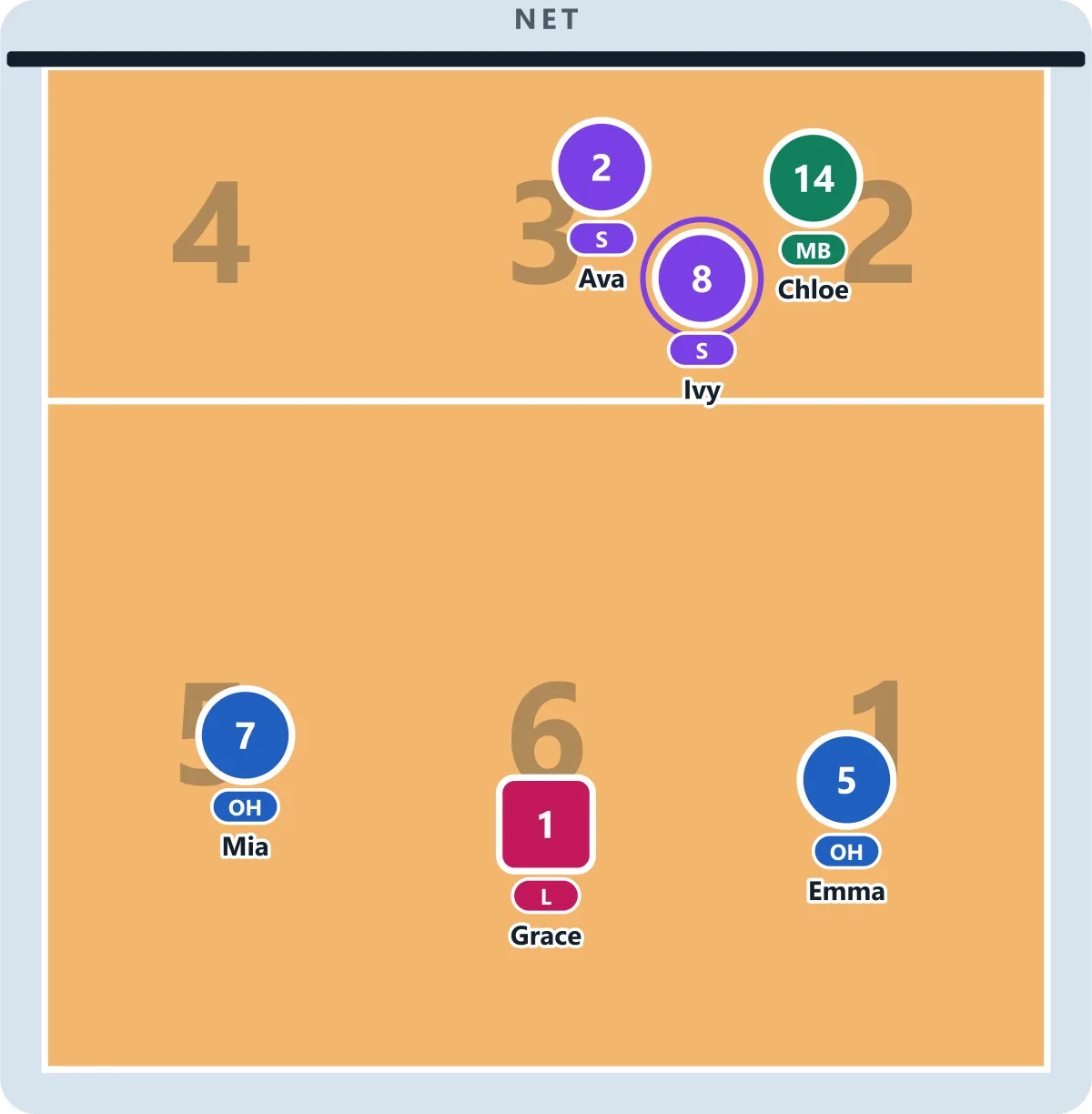
The standard 6-2 serving order is S1, OH1, MB1, S2, OH2, MB2: Ava, Mia (#7), Zoe (#12), Ivy, Emma (#5) and Chloe (#14), with Grace (#1) as the libero. The setters sit three spots apart, so when one is back row the other is front row.
Many teams sub a hitter in for the front-row setter. A common pattern:
- Rotation 4: Ava rotates to the front row. Sub your opposite hitter (say Lily, #9) in for Ava. At the same time Ivy’s spot reaches zone 1, so Ivy comes back in to set if she was subbed out.
- Rotation 1 (next time around): Ava’s spot reaches zone 1. Sub Ava back in for Lily, and sub your second hitter in for Ivy.
That is four substitutions every full trip through the six rotations. Each player re-enters in the same lineup spot. Under NFHS (18 subs) you can run it four times per set, under USAV and NCAA Division I (15) three times. Under FIVB rules (6 subs, and a starter may leave and return only once) it fits only once per set, so check your event. The helper above the guide counts it for your rule set, and the substitution rules page explains limits and re-entry.
6 2 rotation for volleyball: all 6 rotations
Rotations are named by S1’s zone (Rotation 1 = Ava in zone 1). The serve receive patterns repeat: Rotation 4 looks like Rotation 1 with the setters swapped, Rotation 5 like Rotation 2, Rotation 6 like Rotation 3.
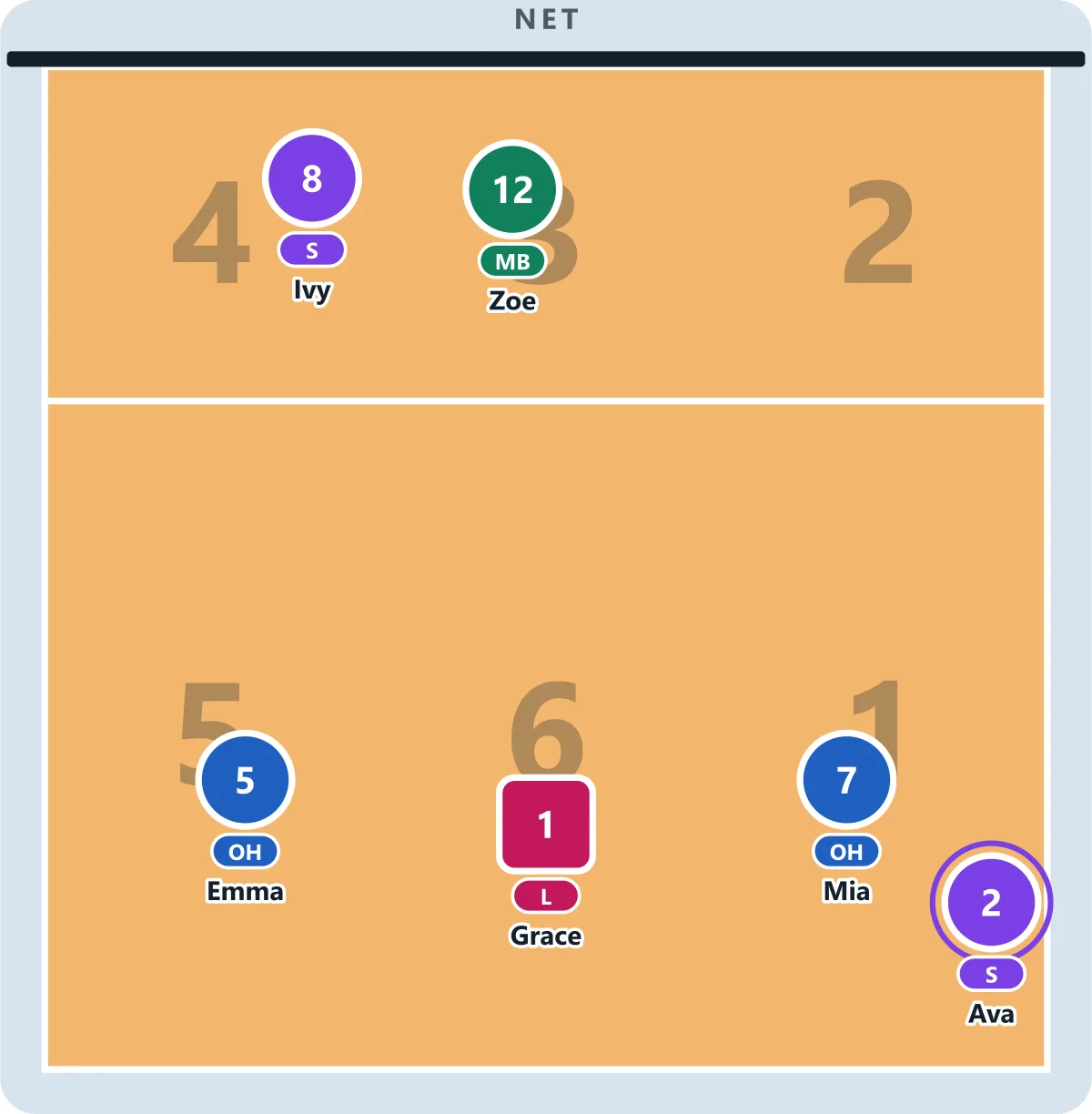
Rotation 1. Ava sets from zone 1, hidden behind Mia in the right passing lane. Ivy, Zoe and Mia are your front-row attackers.
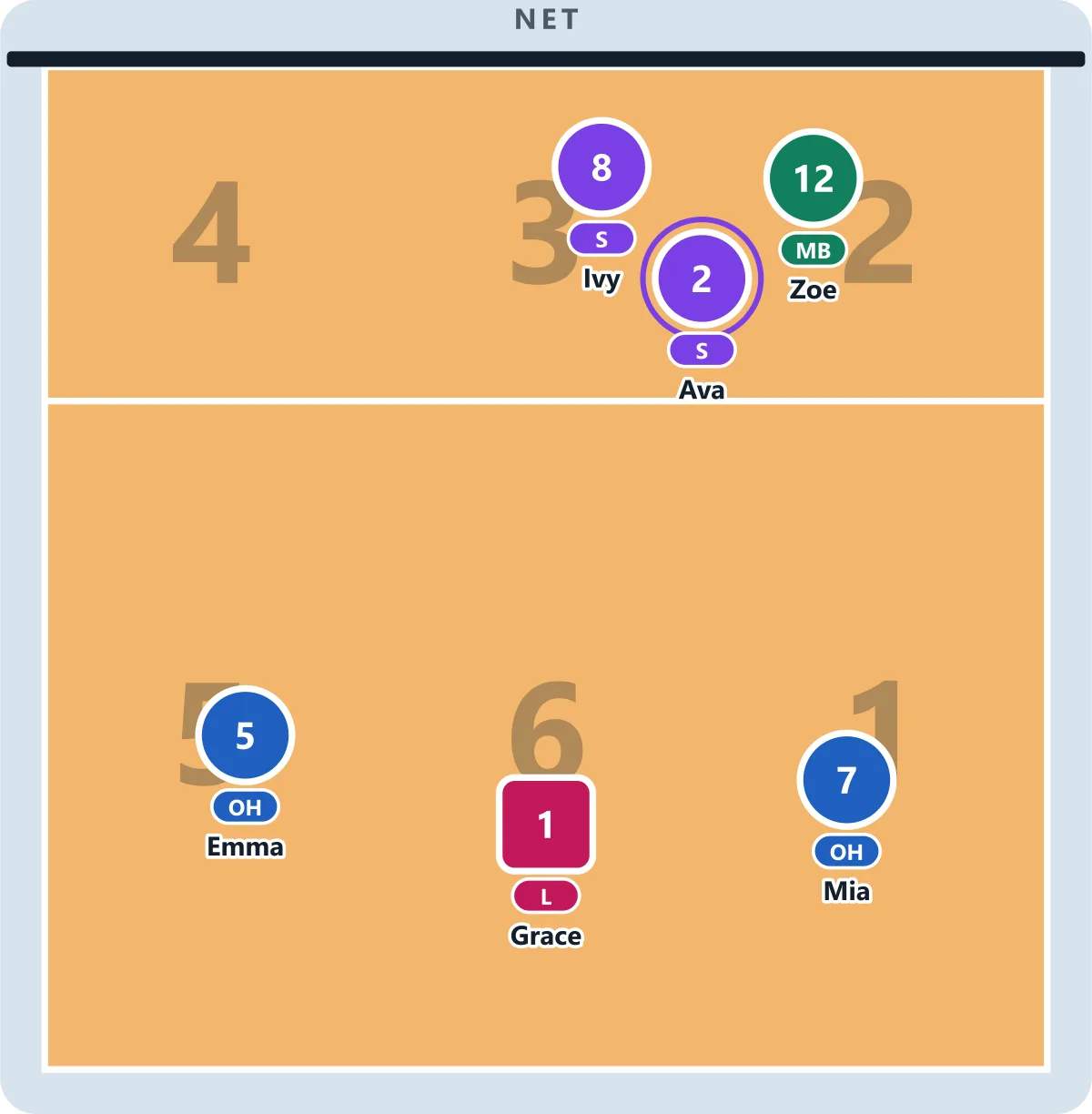
Rotation 2. Ava sets from zone 6. She stands right behind Ivy at the net, because zone 6 only has to stay behind zone 3. Emma passes from left front.
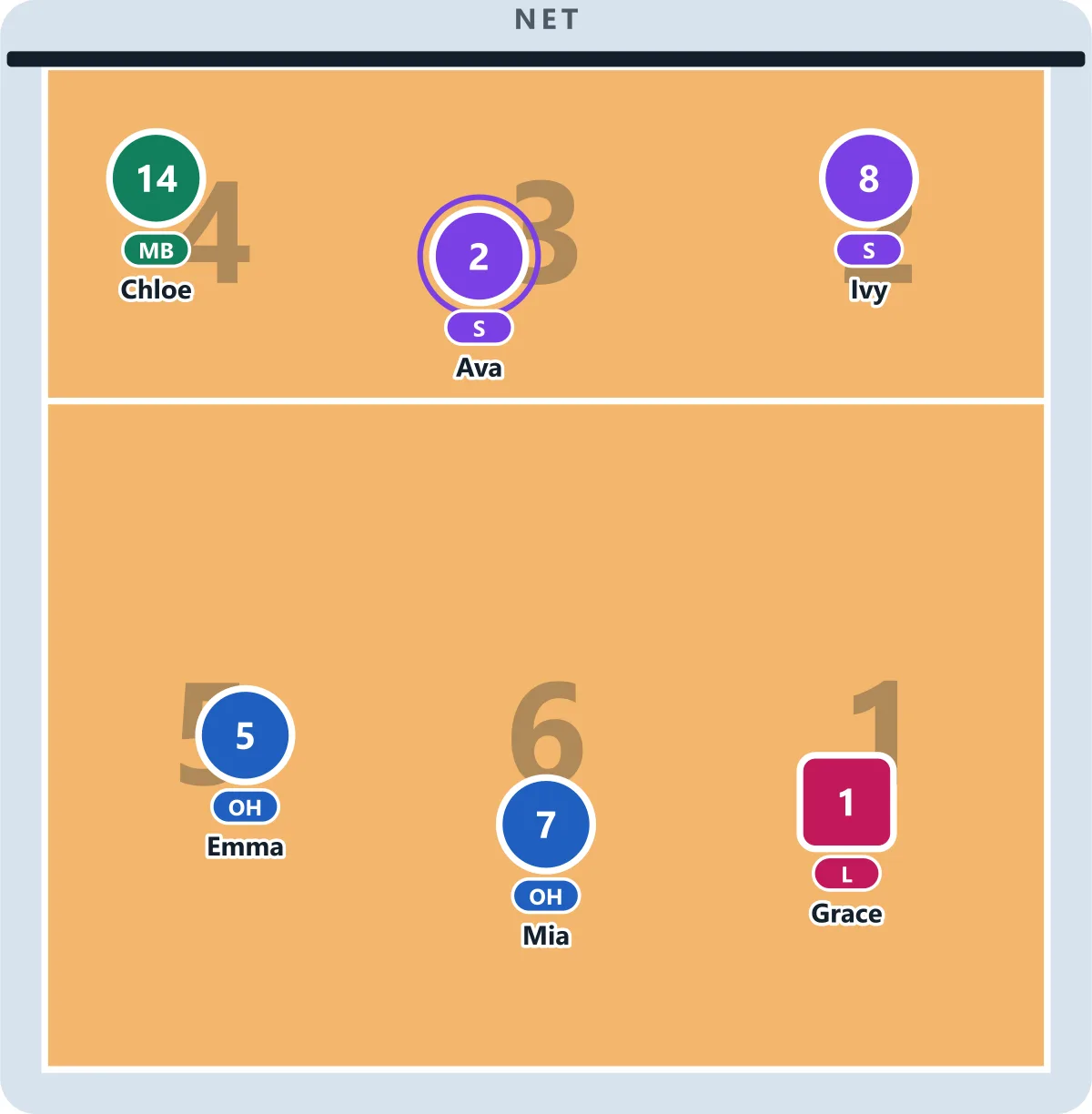
Rotation 3. Ava sets from zone 5, behind Chloe and to the left of Mia. Ivy hits from right front. After this rotation, Ava goes to the front row.
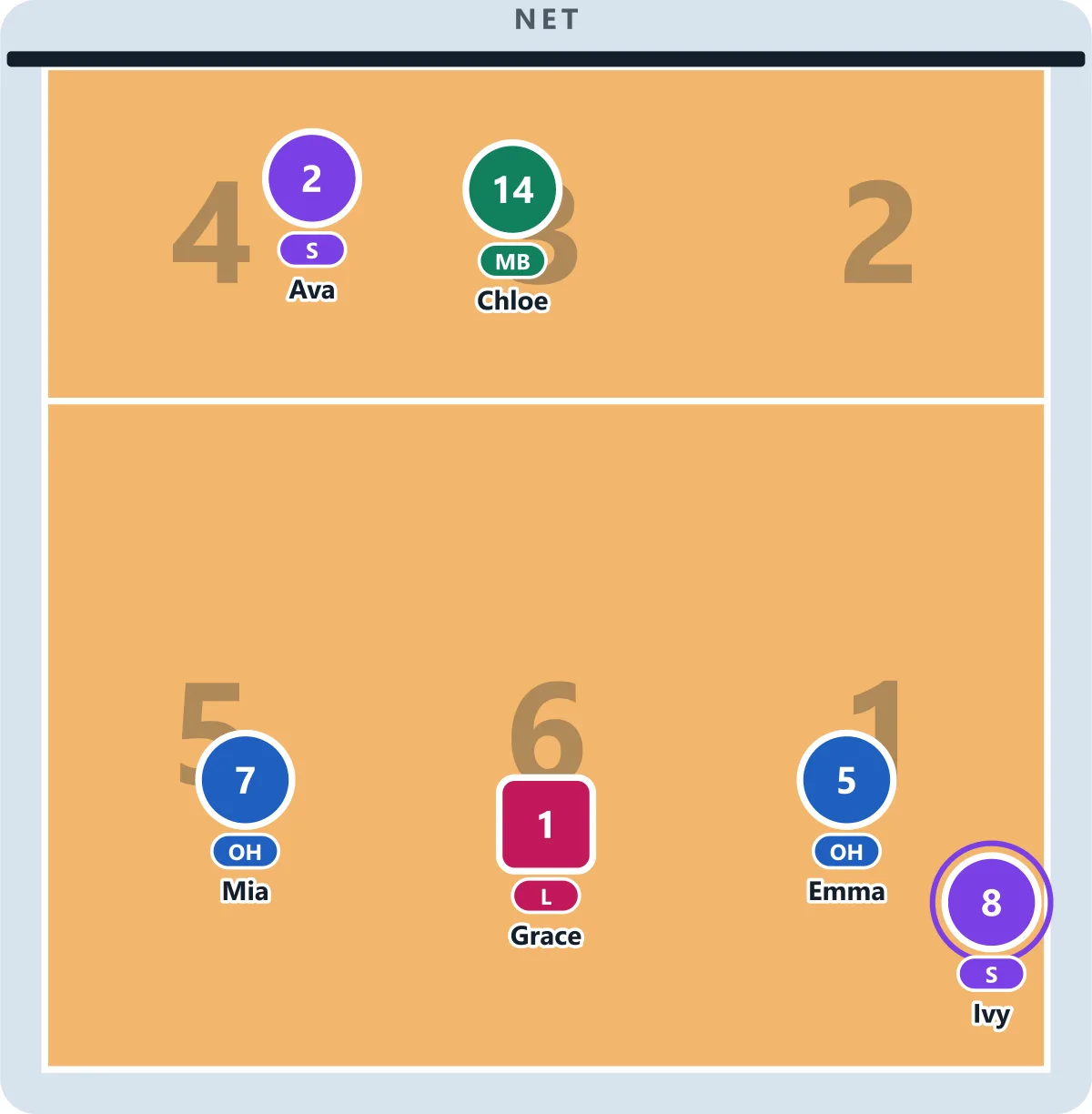
Rotation 4. Ivy reaches zone 1 and takes over setting. Ava is now a front-row hitter, or the player you sub in for her.
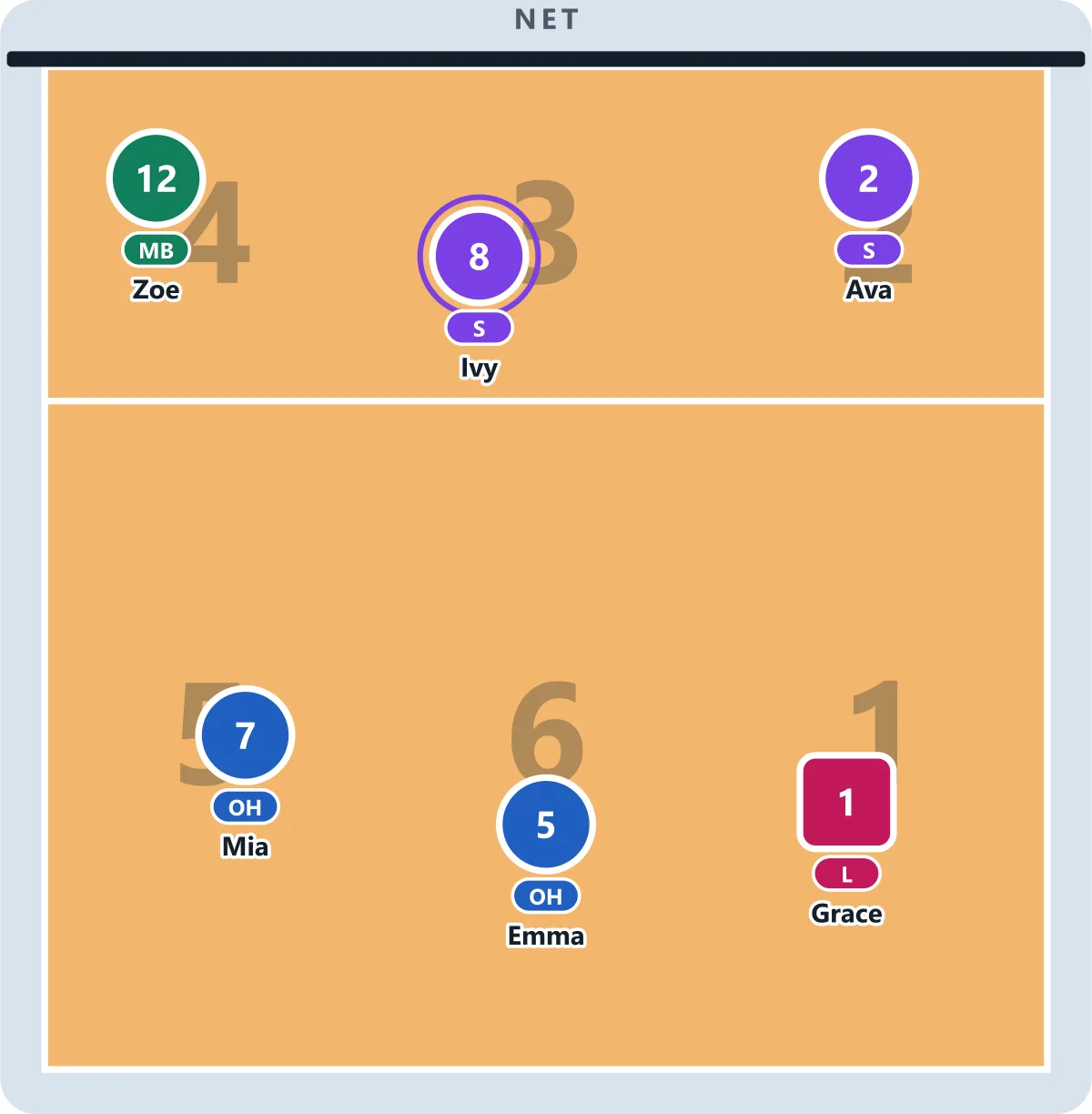
Rotation 5. Ivy sets from zone 6, tucked behind the front-row player in zone 3. Three hitters are still front row.
Rotation 6. Ivy sets from zone 5. On the next side-out Ava reaches zone 1 and the cycle starts again.
6-2 volleyball rotation serve receive
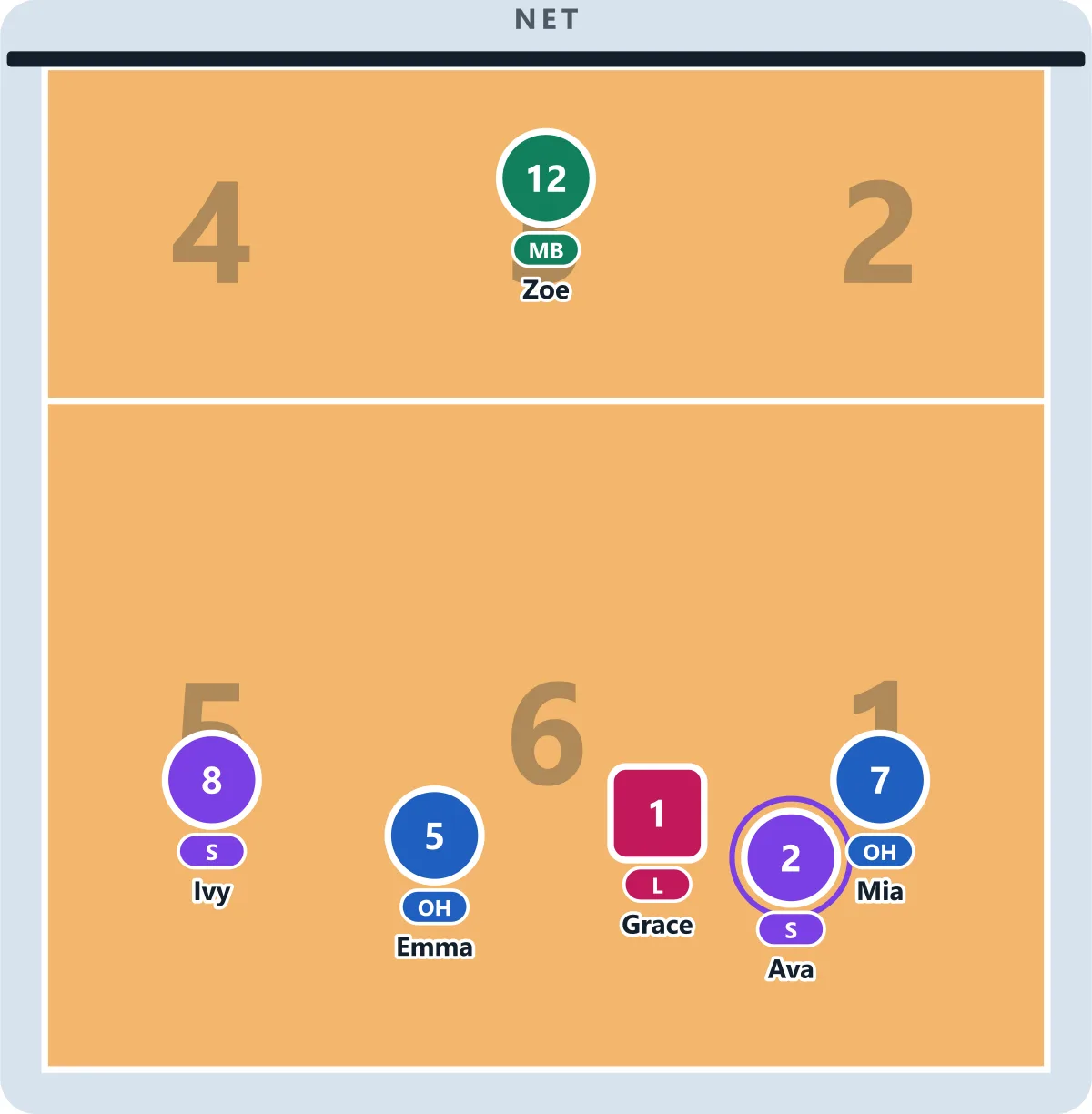
The 6-2 uses the same 3-passer pattern as the 5-1: the libero and both outside hitters pass, front-row players stand near the net, and the back-row setter hides as close to the target as the overlap rule allows. Because the setter is always back row, she always has to hide, which is the main thing to teach.
Want four passers? Add the front-row setter or the opposite to the passing line. The serve receive formations builder makes every rotation with 3, 4 or 5 passers and checks each one for overlap.
The libero in a 6-2
The libero works the same way as in a 5-1. She usually replaces both middles in the back row, comes in when a middle rotates to the back row, and leaves when that spot reaches zone 4. Her replacements do not count as substitutions, which matters in a 6-2 because the setter swaps already use your subs. Under NFHS, USAV and NCAA rules she may serve in one rotation per set; FIVB does not allow it (check your event). See the libero rotation guide for the full pattern.
How to practice a 6-2
- Give both setters the same reps with the same hitters, so timing does not drop after Rotation 3.
- Run serve receive in pairs of rotations that share a pattern (1 and 4, 2 and 5, 3 and 6). Players learn three patterns, not six.
- Rehearse the subs at practice speed: the sub stands at the line, the scorer says the spot, the swap takes seconds.
- In scrimmages, keep a sub count on the bench so the setters never get stuck in the front row.
Who the 6-2 is for
- Two setters, similar level. If one is much better, a 5-1 gives her every rotation.
- Four or more good hitters, so the third front-row attacker is a real threat.
- A sub limit with room, if you plan to sub the front-row setter.
- Developing teams that want two setters to grow. Younger teams often start in a 4-2, where the setter sets from the front row, then move to a 6-2.
6-2 vs 5-1
The 6-2 trades consistency for firepower. With a 5-1 your hitters time every set with one setter and you use few subs, but in three rotations you have only two front-row attackers. With a 6-2 you always have three attackers, but the hitters switch setters every three rotations and you may use up to four subs per trip. See the volleyball rotation systems comparison and its picker if you are deciding.
Common 6-2 mistakes
- The front-row setter forgets to attack. In a 6-2 she is a hitter. Give her sets in practice.
- Running out of subs. Track them. The scoreboard’s match mode counts subs and warns two before your limit.
- Sub into the wrong spot. A player re-enters only in the spot she left. Write the pairs (Ava with Lily, Ivy with your other opposite) on your clipboard.
- Illegal hiding. In Rotations 1 and 4 the setter must stay behind the zone 2 passer and right of the zone 6 player. Check it in the generator.
6-2 volleyball rotation PDF
Print the free 6-2 rotation cheat sheet (PDF), or build your own lineup in the volleyball rotation generator and print a rotation sheet, player cards and a filled lineup sheet in one minute.
Frequently asked questions
What is a 6-2 in volleyball?
A 6-2 is an offense with two setters placed across from each other in the lineup. The setter in the back row sets, so the setter in the front row can attack. The 6 means six players hit at some point and the 2 means two setters. You always have three front-row attackers, which makes it a strong offense for teams with good hitters.
What does 6-2 mean in volleyball?
It describes the lineup: six possible hitters and two setters. Each setter sets for three rotations, while she is in the back row (zones 1, 6 and 5). When she rotates to the front row she becomes a right-side hitter, and the other setter takes over. You will also see it written 6 2, 62 or "6 and 2".
How do you run a 6-2 volleyball rotation?
Put the two setters across from each other: S1, OH1, MB1, S2, OH2, MB2 in serving order. The back-row setter always sets and hides near the net in serve receive. Decide whether the front-row setter hits or subs out for an opposite hitter. If you sub, plan the four subs per trip through the rotations and track them so you stay under your limit.
How many subs does a 6-2 use?
If both setters sub with a hitter, a full trip through the six rotations uses four substitutions: each setter goes out once and comes back once. With an 18-sub limit you can do that four times in a set; with 15 subs, three times. Teams that let the front-row setter hit use no subs for this.
Is a 6-2 or 5-1 better?
Neither is better for every team. A 6-2 gives you three front-row hitters all the time but needs two good setters and more subs. A 5-1 gives your hitters one setter to time with and needs fewer subs. Teams with one standout setter usually run a 5-1; teams with two solid setters and deep hitting often choose the 6-2.
Who should run a 6-2?
Teams with two capable setters, at least four solid hitters and room in the sub limit. It is common in high school, club and middle school teams that are developing two setters. Very young teams usually start with a 6-6 or 4-2, where the setter sets from the front row and the passes do not need to be perfect.
Can the setter attack in a 6-2?
Yes. The front-row setter is a full front-row player, so she can attack, block and dump the ball. The back-row setter may set, but as a back-row player she cannot attack the ball above the net from in front of the attack line. That is why the back-row setter sets and the front-row setter hits.
Rules checked
Rule sets used on this page: NFHS (high school) 2026-27, USAV (club) 2025-27, NCAA (college) 2026 and FIVB (international) 2025-28. Where leagues differ, the tool makes it a setting. Always check your league or state association.
- Substitution: re-entry: USAV 15.6d (differs by league — check yours)
- Overlap: which pairs: USAV 7.4.2-7.4.3; NFHS 6-4-3
- Substitution limit per set: USAV 15.1, 15.6; NCAA 2026 (differs by league — check yours)
- Libero: where: NFHS 10-4-1a
Last reviewed: by EmproIT. See how we check the rules.