Quick answer
Teams rotate one spot clockwise only after a side-out, which means winning a rally while the other team served. The player in zone 2 (right front) moves to zone 1 (right back) and serves. You do not rotate when you win a point on your own serve. The serving order stays the same all set.
Volleyball rotations explained: the zones 1 to 6
Each half of the court has six zones. Number them from the server’s spot and go counter-clockwise:
- Zone 1: right back (the serving spot)
- Zone 2: right front
- Zone 3: middle front
- Zone 4: left front
- Zone 5: left back
- Zone 6: middle back
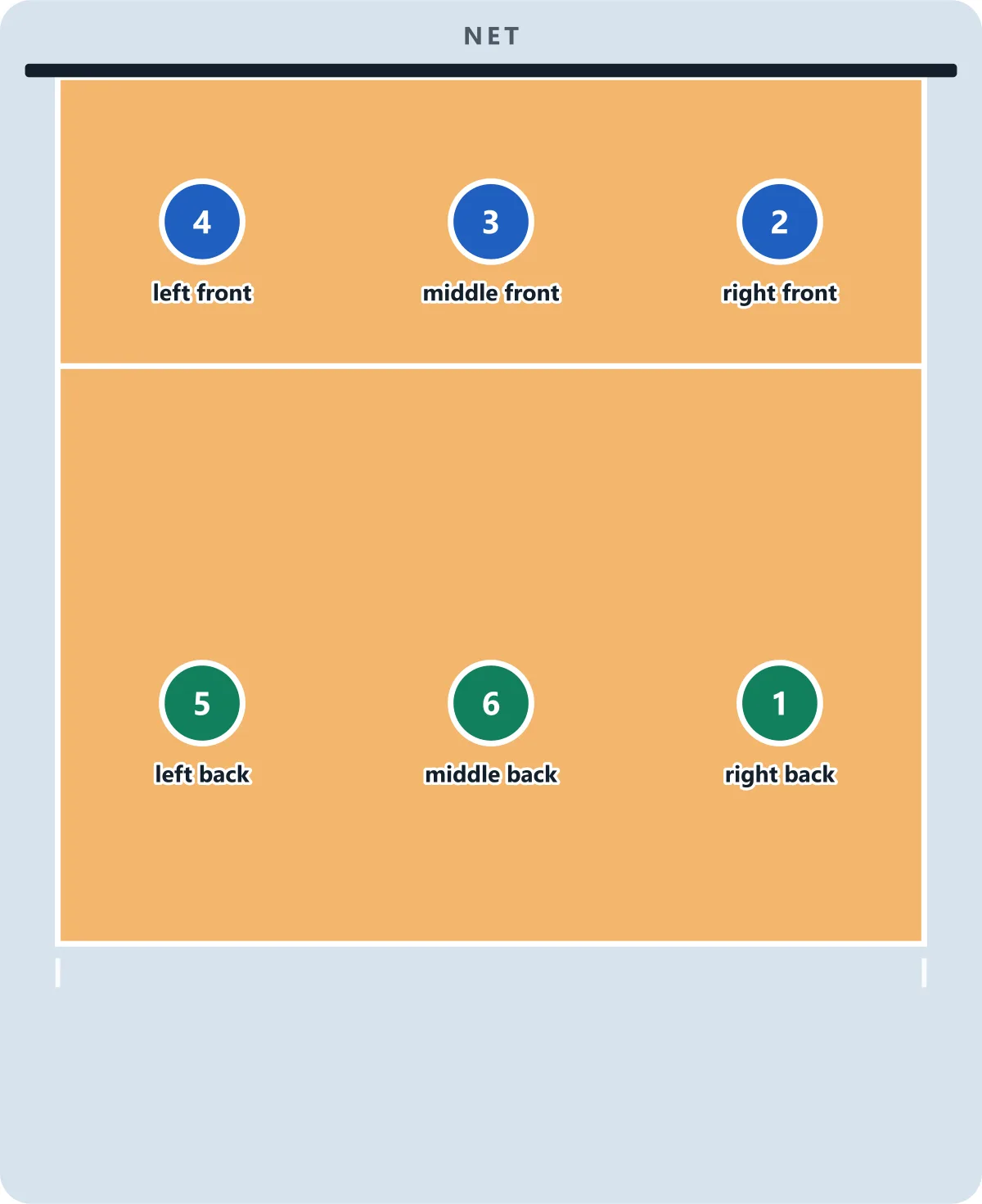
Zones 4, 3 and 2 are the front row. Zones 5, 6 and 1 are the back row. Back-row players cannot attack the ball above the net from in front of the attack line, and they cannot block. That is why the rotation matters so much.
How to rotate in volleyball: clockwise, one spot
To rotate in volleyball, every player moves one zone clockwise: 2 to 1, 1 to 6, 6 to 5, 5 to 4, 4 to 3 and 3 to 2. The player who moved from zone 2 to zone 1 serves.
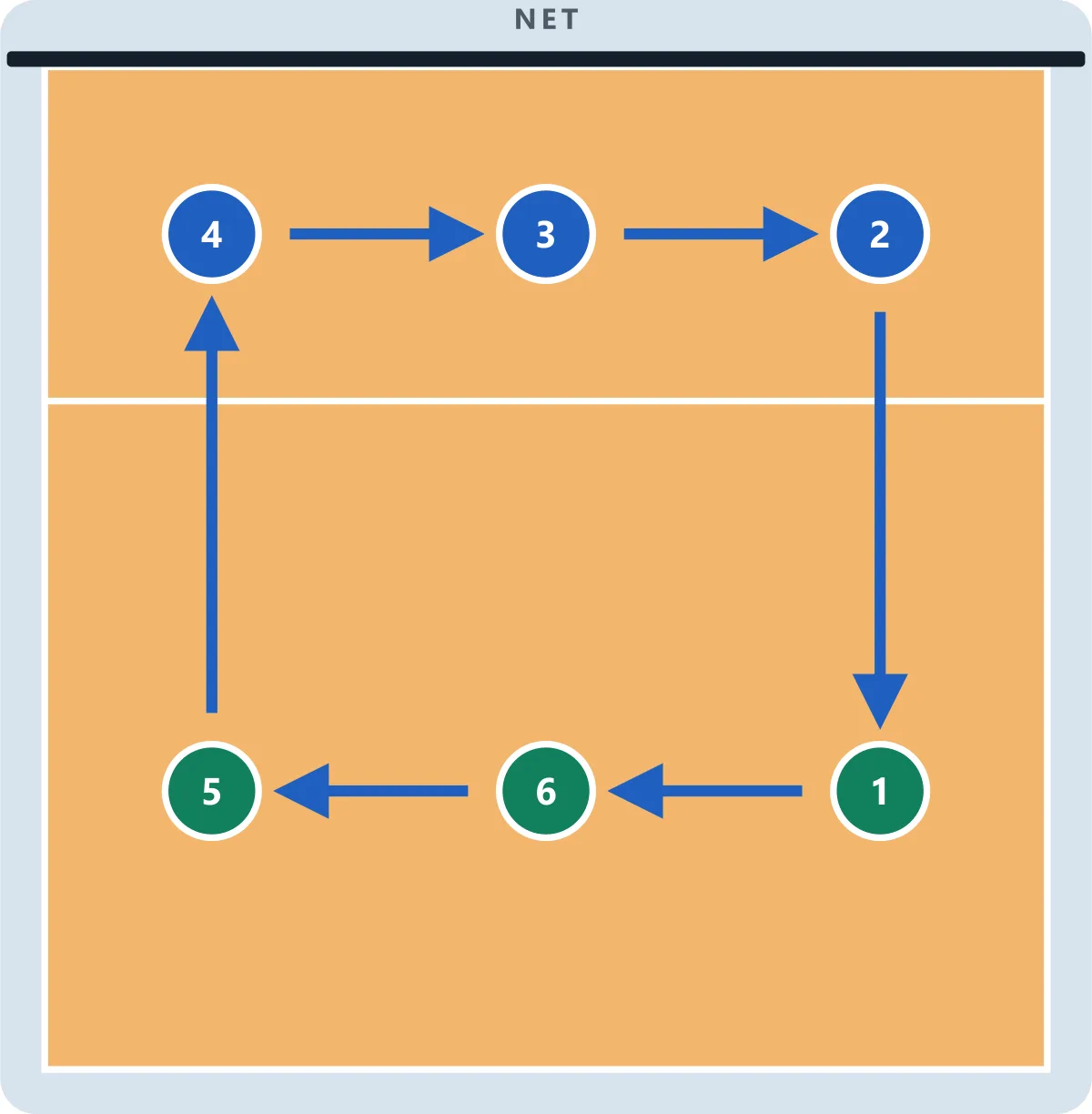
A handy check for players: “Who serves next?” It is always the player in zone 2 right now.
When you rotate: the side-out
Volleyball uses rally scoring: every rally gives a point to someone. What happens next depends on who served:
- Your team served and won the rally: you get the point, and the same player serves again. No rotation.
- The other team served and you won the rally: that is a side-out. You get the point and the serve, and you rotate one spot before you serve.
Try it in the side-out simulator above: tap “Opponent won the rally”, then “Your team won the rally” and watch every player on your team move.
A side-out, step by step
Here is one rotation in our sample team. Ava (#2) is in zone 1, Mia (#7) in zone 2, Zoe (#12) in zone 3, Lily (#9) in zone 4, Emma (#5) in zone 5 and Chloe (#14) in zone 6.
- The other team serves. Your team passes, sets and attacks. The ball lands in: you win the rally. That is a side-out.
- You get the point and the serve. The score goes up by one for your team.
- Everyone rotates one spot clockwise. Mia moves from zone 2 to zone 1. Ava moves from zone 1 to zone 6. Chloe moves from 6 to 5, Emma from 5 to 4, Lily from 4 to 3 and Zoe from 3 to 2.
- Mia serves. She was next in the serving order.
- You win again on your own serve. Point for your team, and Mia serves again. Nobody moves.
- You lose a rally. The other team gets the point and the serve. Your team stays where it is until you win the serve back.
Rotation vs zone vs role
Three words get mixed up all the time:
- A rotation is a lineup state: “Rotation 1” means one of the six arrangements your team plays. Many coaches number rotations by where the setter is (Rotation 1 = setter in zone 1); others number them in the order played from the start of the set.
- A zone is a spot on the court: zone 1 is always right back, in every rotation.
- A role (or position) is a player’s job: setter, outside hitter, middle blocker, opposite, libero, defensive specialist. See volleyball positions for each job.
So “Mia is in zone 2 in Rotation 1” is a full, clear sentence. This site always writes “Rotation” for the lineup state and “zone” for the spot.
The server and the serving order
The lineup you hand in before the set fixes the serving order for the whole set. The first player serves, then the next player in the order after each side-out, and so on. If you receive first, the player who starts in zone 2 serves first, after your first side-out.
The server is the one player who is free at the serve: she can stand anywhere behind the end line, and she is not part of the overlap rule. Everyone else must be in rotation order at the moment the ball is served. After the serve contact, anyone can move anywhere.
“Out of rotation” and the wrong server
Two different mistakes are both called “out of rotation”:
- Wrong server. The wrong player serves. That is a rotation fault: the other team gets the point and the serve, and the order is corrected. Under USA Volleyball rules, points won while out of order are also cancelled if found in time.
- Overlap. Players are in the right order but stand in the wrong place relative to each other at the serve. NFHS calls it illegal alignment (loss of rally); USA Volleyball, NCAA and FIVB call it a positional fault (point and serve to the opponent). The volleyball rotation rules page explains the 7 overlap pairs and has a checker.
The scoreboard’s match mode shows the next server, so the bench can catch a wrong server before the whistle.
Rotating in volleyball after the serve: switching
Teams rotate legally at the serve, then switch to their best spots. A setter who starts in zone 4 slides right to set; an outside hitter who starts in zone 2 moves to the left. That is legal because the overlap rule only applies at the moment of the serve. Then the team sets up its base defense.
Rotational defense in volleyball
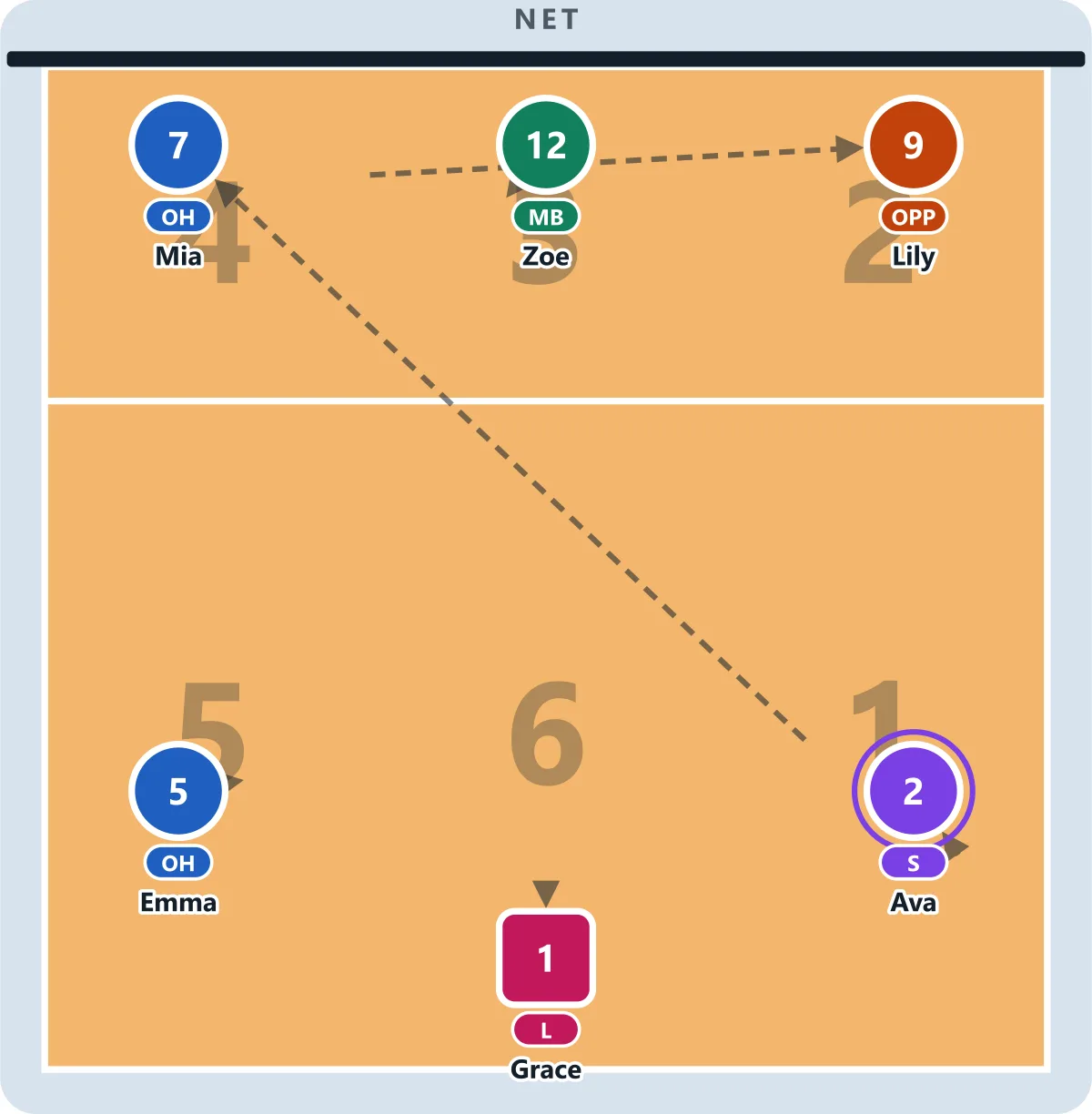
“Rotation” also has a second meaning: a rotational defense (or rotation defense). It is a defensive system, not the serving rotation. In a rotational defense the back-row players rotate toward the attack: the right back moves up to cover tips, the middle back slides toward the line, and the left back covers the cross-court angle. In a perimeter defense the back row stays deep around the edge of the court.
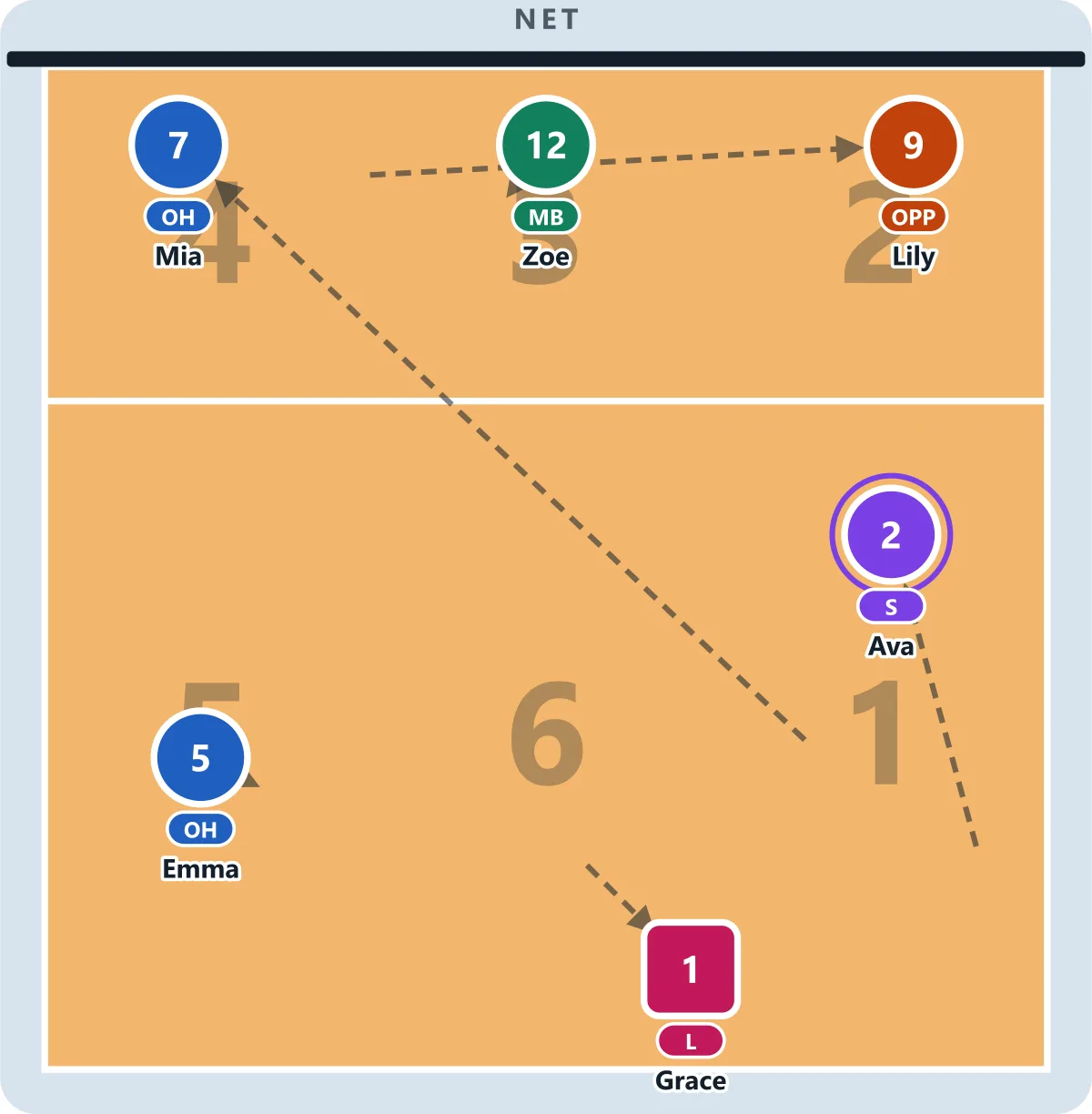
You can pick perimeter or rotational base defense in the generator’s settings and see every rotation update.
Do pros rotate?
Yes. Every indoor team rotates, from 10U to the Olympics. Pros look like they stay in one spot because they switch right after the serve, use a libero for the middle blockers in the back row, and run systems like the 5-1 where the setter always sets. The rotation still decides who serves and who is in the front row.
Beach vs indoor
Beach doubles has two players and no zones to rotate through, so there is no overlap rule to learn; partners take turns serving in order. Everything on this page is about indoor six-player volleyball. If your team plays a different format, compare it with the rotation systems guide, and build your lineup in the volleyball rotation generator.
Frequently asked questions
What does side out mean in volleyball?
A side-out is when the receiving team wins the rally. It earns a point and the serve, and the team rotates one spot clockwise before serving. "Siding out" well means you win the rally after the other team serves. It is the most important number for many coaches, because a team that sides out every time never falls behind.
When do you rotate in volleyball?
Only after a side-out: when your team wins a rally that the other team served. You rotate before your first serve of that turn. If your team wins a point on its own serve, nobody rotates and the same player serves again. A team that receives first rotates right after its first side-out.
Which way do you rotate in volleyball?
Clockwise, looking at your own court from behind the end line. The right-front player moves back to serve, right back moves to middle back, middle back to left back, left back to left front, left front to middle front, and middle front to right front. In zone numbers: 2 to 1, 1 to 6, 6 to 5, 5 to 4, 4 to 3 and 3 to 2.
How does rotation work in volleyball?
The lineup sets a serving order for the whole set. Each player starts in one of six zones. Every time the team wins the serve back, all six move one zone clockwise and the next player in the serving order serves from zone 1. At the serve, players must be in their rotation order; after the serve they can move anywhere.
Do you have to rotate in volleyball?
Yes, in indoor six-player volleyball every rule set requires the team to rotate after each side-out and to serve in order. Players can switch to their specialty positions after the serve, which is why it looks like some players never move. A team that serves out of order commits a rotation fault and loses the rally.
What happens if a team is out of rotation?
Serving out of order is a rotation fault: the other team gets a point and the serve, and the order is corrected. Under USA Volleyball rules, points scored while out of order are also cancelled if the mistake is found in time. Standing in the wrong place at the serve is a separate fault, called an overlap or illegal alignment.
Do you rotate when you serve?
No. You rotate when you win the serve back from the other team, then you serve. While your team keeps winning points on its own serve, the same server keeps serving and nobody rotates. In some youth leagues a serve limit forces a rotation after 3 or 5 serves in a row; that is a league rule.
Rules checked
Rule sets used on this page: NFHS (high school) 2026-27, USAV (club) 2025-27, NCAA (college) 2026 and FIVB (international) 2025-28. Where leagues differ, the tool makes it a setting. Always check your league or state association.
- Overlap: server: USAV 7.4; NFHS 6-4-3
- Overlap penalty: NFHS 6-4 Penalties
Last reviewed: by EmproIT. See how we check the rules.