Quick answer
A 5-1 is a volleyball system with one setter and five hitters. The setter sets in all six rotations, from the back row and the front row. When she is in the back row (Rotations 1-3) you have three front-row attackers; when she is in the front row (Rotations 4-6) you have two. The opposite lines up across from her.
What is a 5-1 volleyball rotation?
A 5-1 (also written 5 1 or “5 and 1”) is an offense with one setter and five hitters. The setter takes the second ball in every rotation. When she is in the back row she runs in from the right side to set. When she is in the front row she sets from the net and can attack the second ball herself.
The number tells you the lineup: 5 hitters, 1 setter. That makes the 5-1 different from a 6-2, where two setters share the job. Most high school varsity, club and college teams run a 5-1 because the hitters always get sets from the same person.
Pros
- One setter means consistent tempo, location and communication.
- Your best setter touches the ball in every rotation.
- Fewer substitutions than a 6-2.
- The setter can dump or attack from the front row.
Cons
- Only two front-row attackers in half the rotations.
- The setter runs a long way when she starts in zone 1.
- One setter needs serious conditioning and a backup plan.
5-1 volleyball rotation setter: lineup order and why
The standard 5-1 serving order is S, OH1, MB1, OPP, OH2, MB2. In our sample team that is Ava (#2, setter), Mia (#7, outside), Zoe (#12, middle), Lily (#9, opposite), Emma (#5, outside) and Chloe (#14, middle), with Grace (#1) as the libero.
Why this order works:
- The setter and opposite are across from each other. One of them is always in the front row, so you always have a right-side blocker and a right-side attacker.
- The two outsides are across from each other, so one strong passer is front row and one is back row.
- The two middles are across from each other, so one middle is always at the net and the libero can replace the back-row middle.
Some teams use “middle after setter” (S, MB1, OH1, OPP, MB2, OH2). It changes which hitter is in front of the setter in each rotation. You can switch it in the generator settings and see every formation update.
All 6 rotations of the 5-1 volleyball rotation (with diagrams)
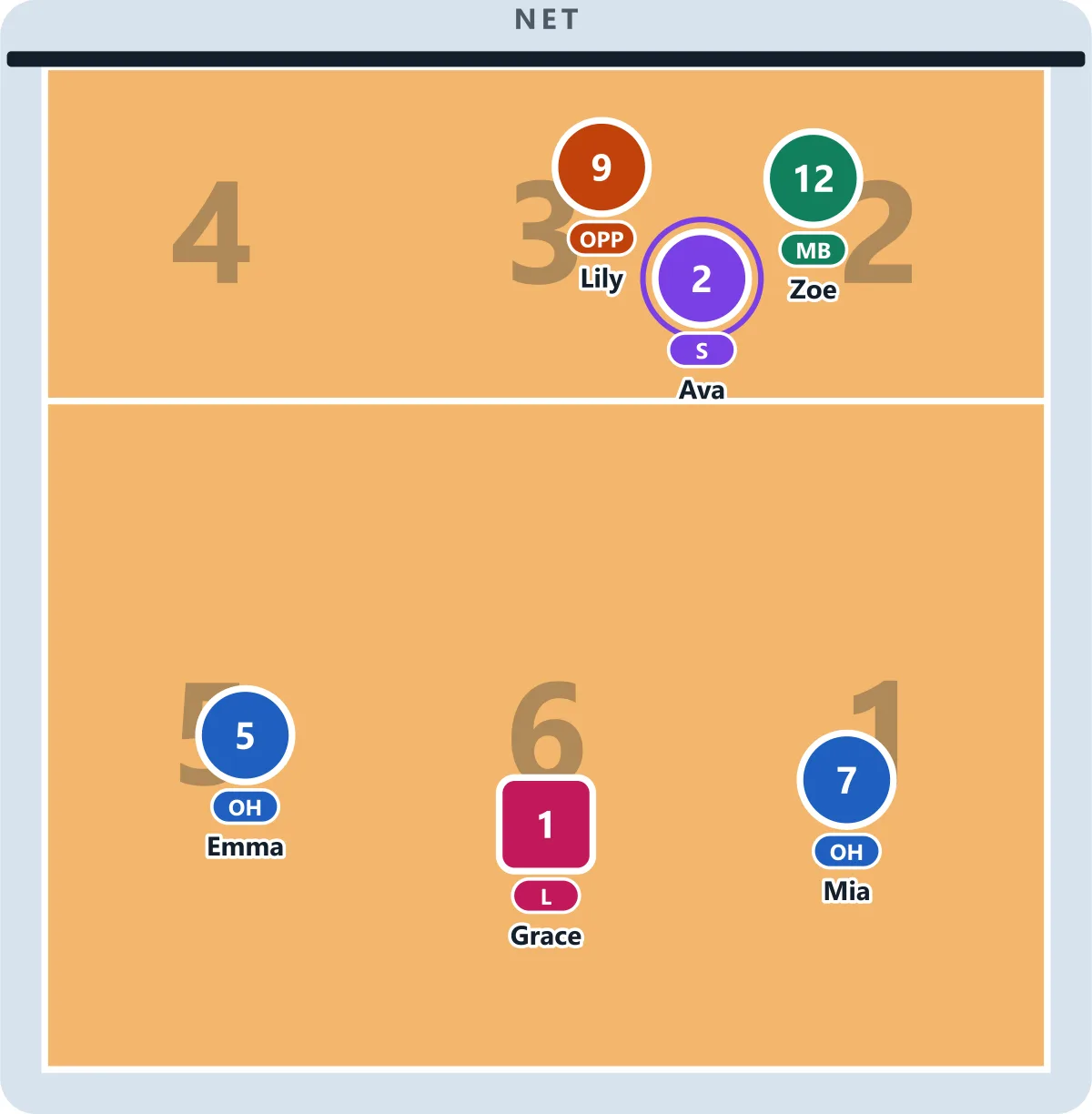
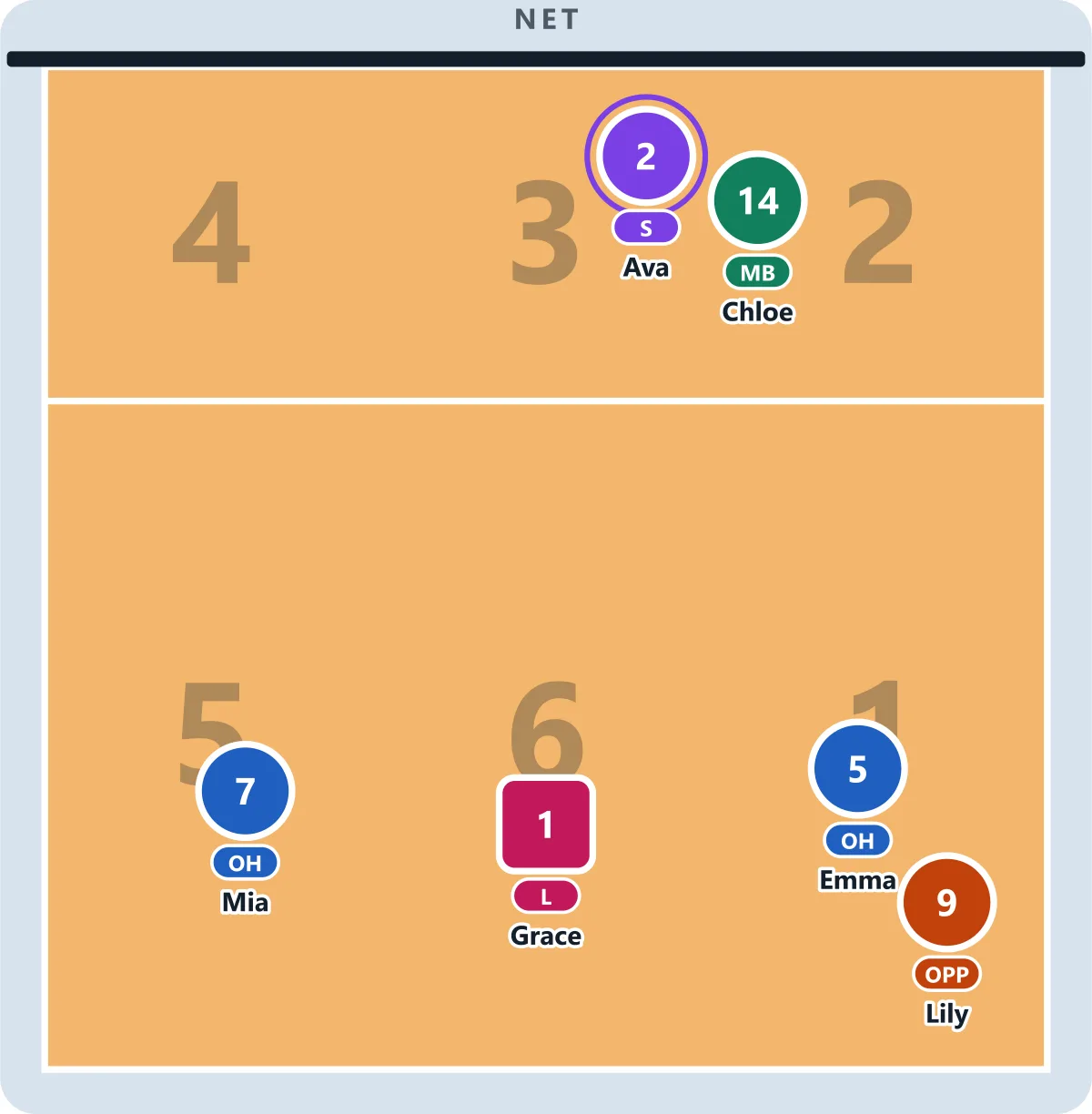
Rotations below are named by the setter’s zone: Rotation 1 = setter in zone 1. Remember the difference: a rotation is a lineup state, and a zone is a spot on the court. Each diagram shows a legal 3-passer serve receive.
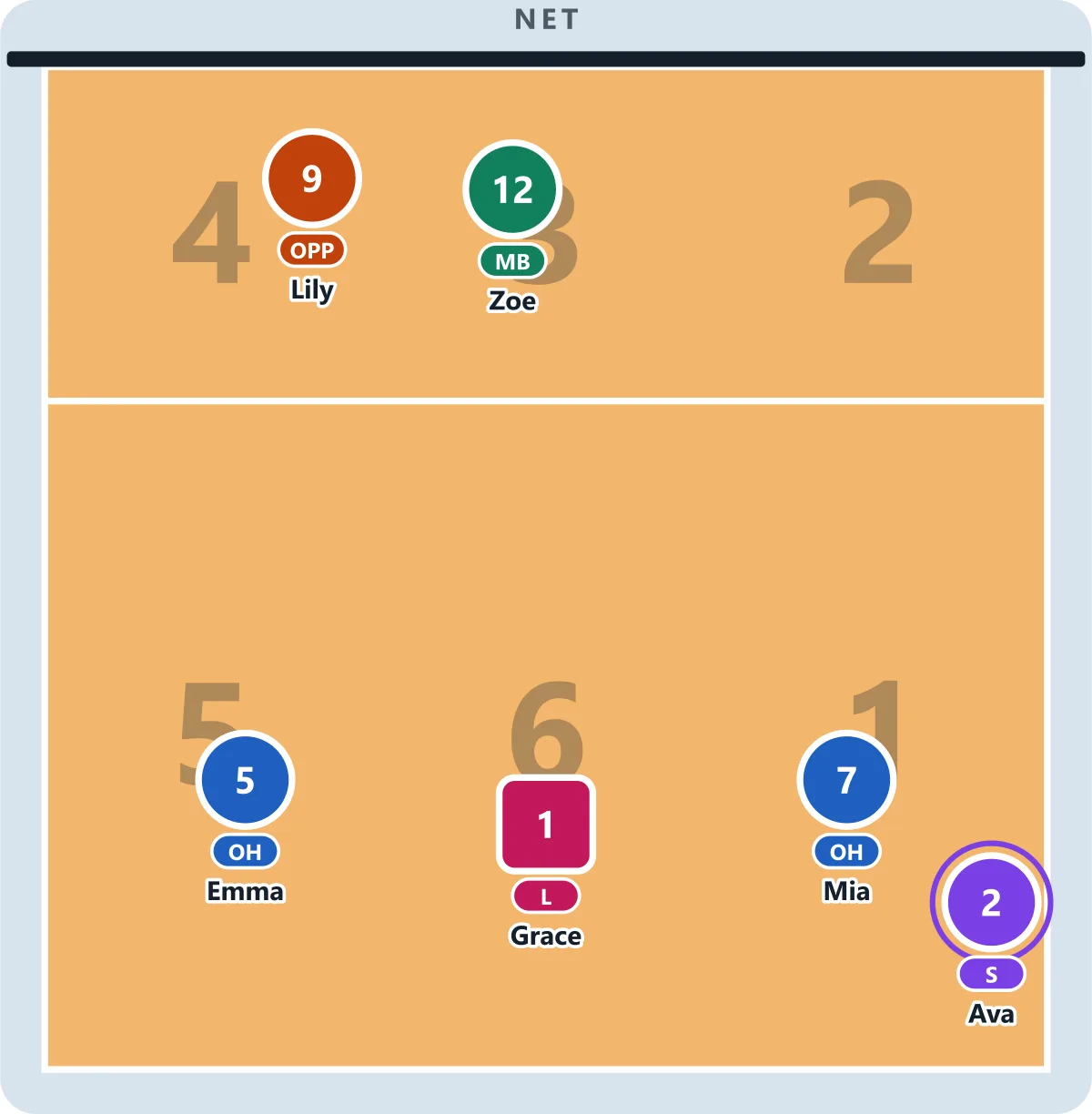
Rotation 1 (setter in zone 1). Ava starts right back. She must stay behind Mia, who passes in the right lane, so she hides just behind her and sprints to the target on the serve. You have three hitters at the net: Lily, Zoe and Mia.
Rotation 2 (setter in zone 6). Ava is middle back. She must stay behind Lily (zone 3) and between Grace (zone 5) and Mia (zone 1), so she tucks in right behind Lily near the net. This is a short trip to the target.
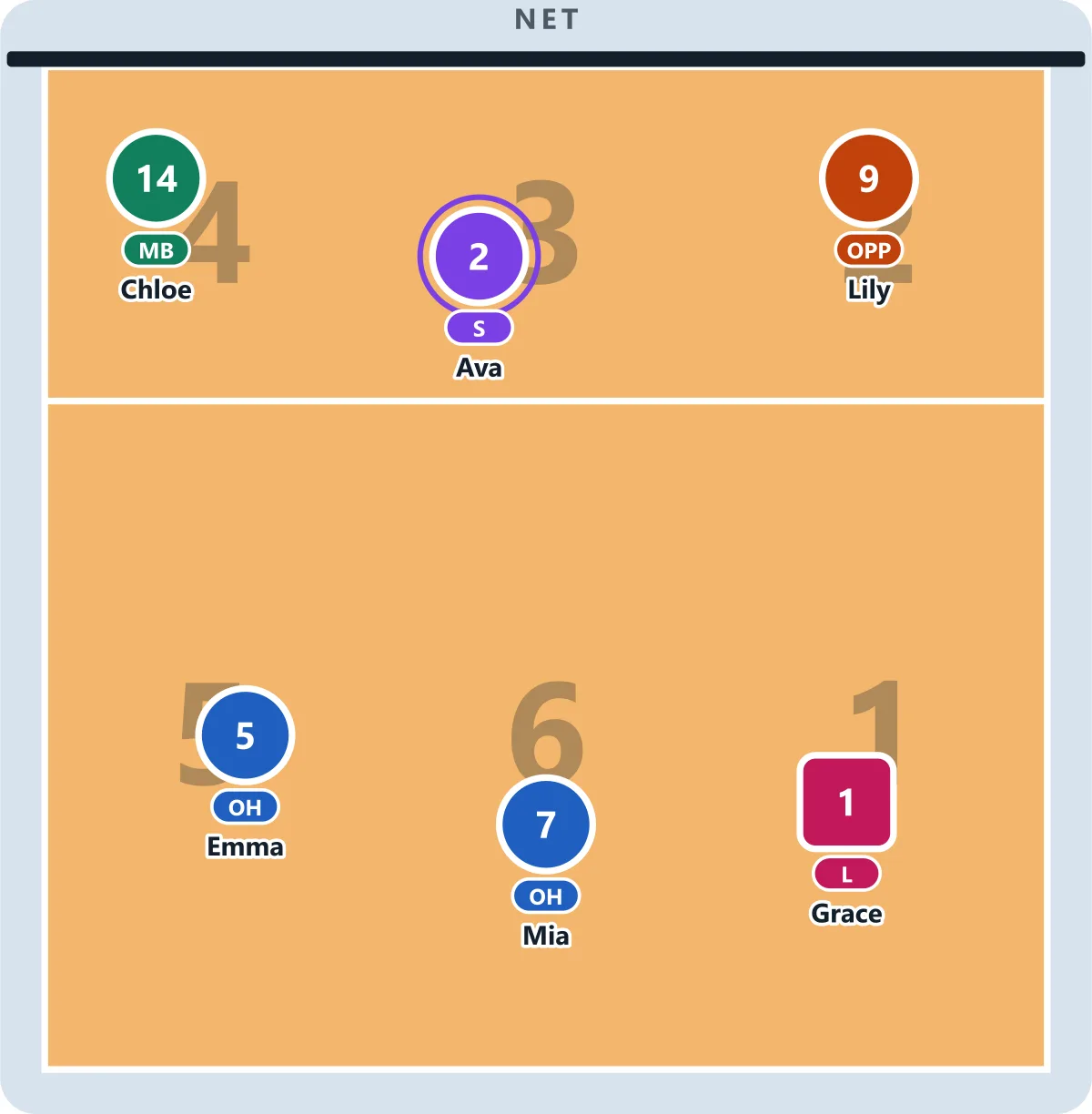
Rotation 3 (setter in zone 5). Ava is left back. The only player she must stay behind is Chloe in zone 4, and she must stay left of Mia in zone 6. Chloe stays at the net, so Ava can stand close to the net in the middle of the court.
Rotation 4 (setter in zone 4). The setter is now front row, and you are down to two attackers: Chloe and Emma. Ava slides right along the net, but Chloe must stay to her right. Many coaches see this as the weakest rotation.
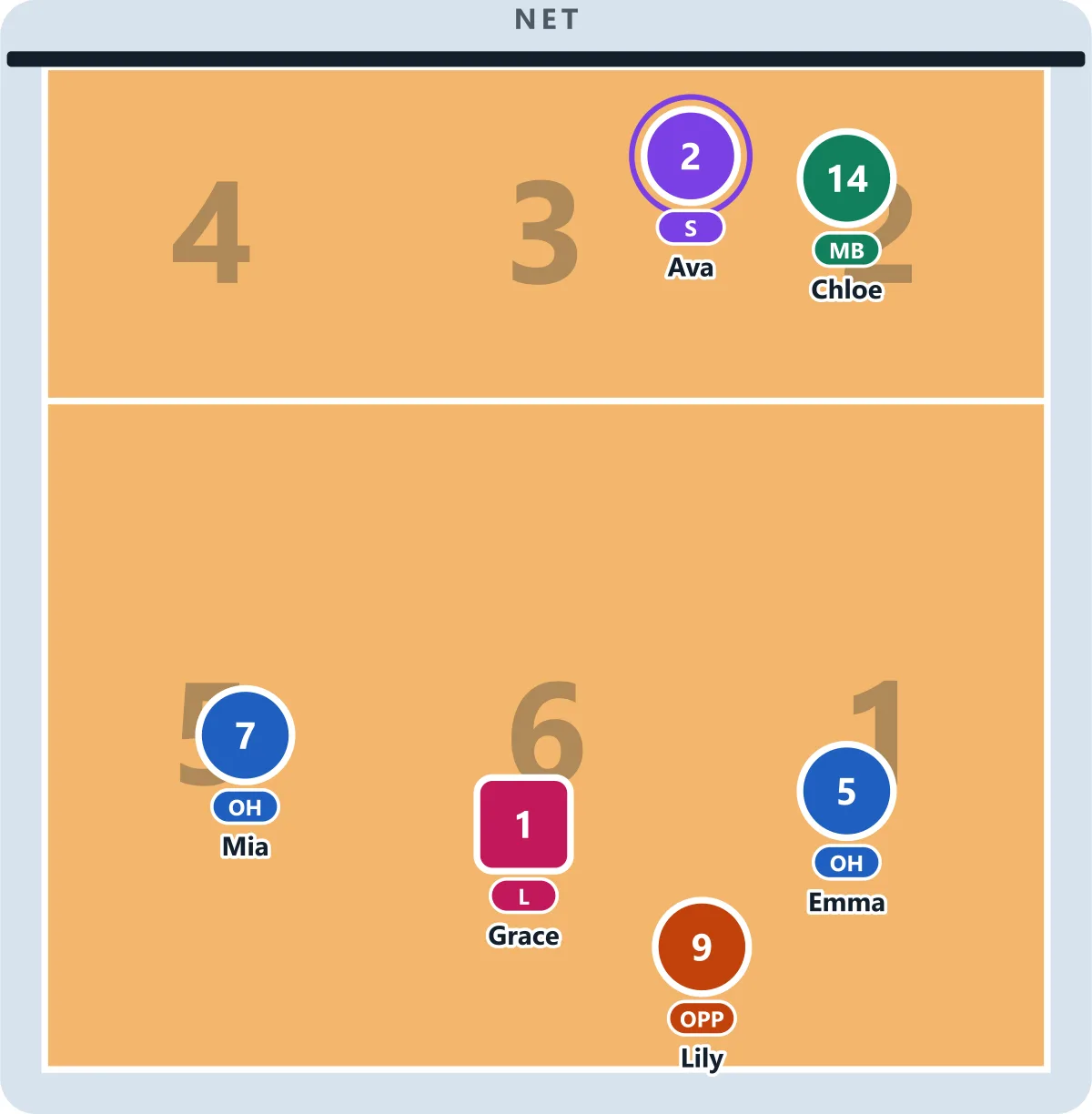
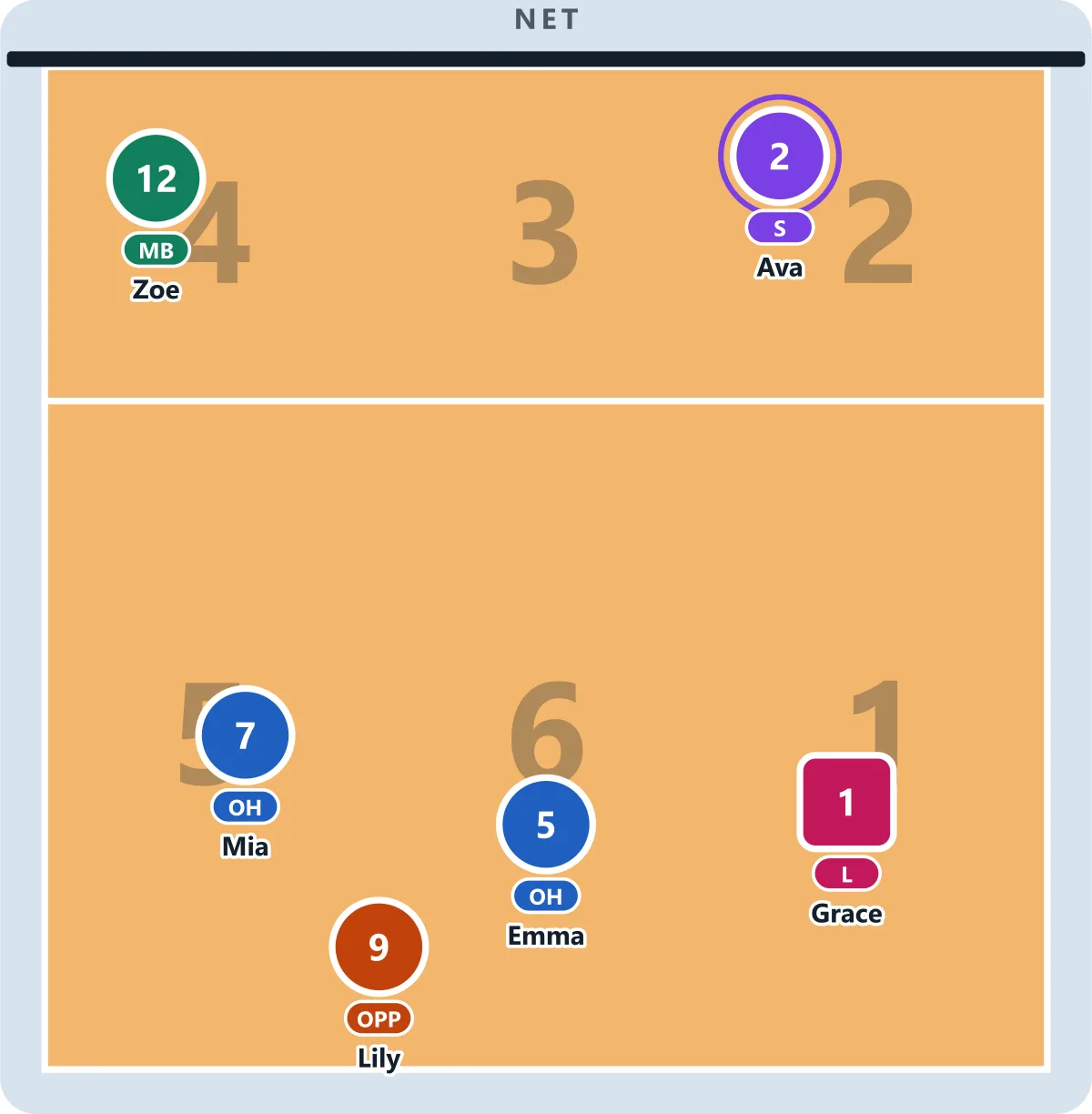
Rotation 5 (setter in zone 3). Ava starts in the middle of the net, next to the target. Lily is back row and stays deep behind the passers. Mia and Chloe are your two attackers.
Rotation 6 (setter in zone 2). Ava is already at the target. Zoe tucks into the left-front corner so Mia can pass from zone 3. Front-row setters can attack a tight pass, which is a great weapon here.
5-1 rotation diagram: serve receive and hiding the setter
In serve receive the libero and both outside hitters pass (a 3-passer pattern). Everyone else gets out of the way: front-row hitters stand near the net close to their attack lane, and the back-row setter “hides” as close to the target as the overlap rule allows.
The setter can only hide behind or beside the players she is compared with at the serve. Zone 1 is compared with zone 2 (front to back) and zone 6 (side to side). Zone 6 is compared with zones 3, 5 and 1. Zone 5 is compared with zones 4 and 6. That is why the setter’s spot changes in every rotation. See the overlap rules for all 7 pairs.
Want 4 or 5 passers? The serve receive formations page builds every rotation with 3, 4 or 5 passers and checks each one.
The libero in a 5-1 volleyball system
Most 5-1 teams use the libero for both middles in the back row. The libero comes in when a middle rotates from zone 2 to zone 1 and loses the serve, and the middle comes back when that spot reaches zone 4. Under NFHS, USAV and NCAA rules the libero may serve in one rotation per set; under FIVB rules she may not serve (check your event). Read where the libero goes in each rotation for the full swap pattern.
Base defense and switching in a 5-1
After the serve, players switch to their specialty spots:
- The setter goes right: right-front block, or right back on defense.
- Outside hitters go left.
- Middles go middle; the libero plays middle back (or left back if you prefer).
- The opposite goes right.
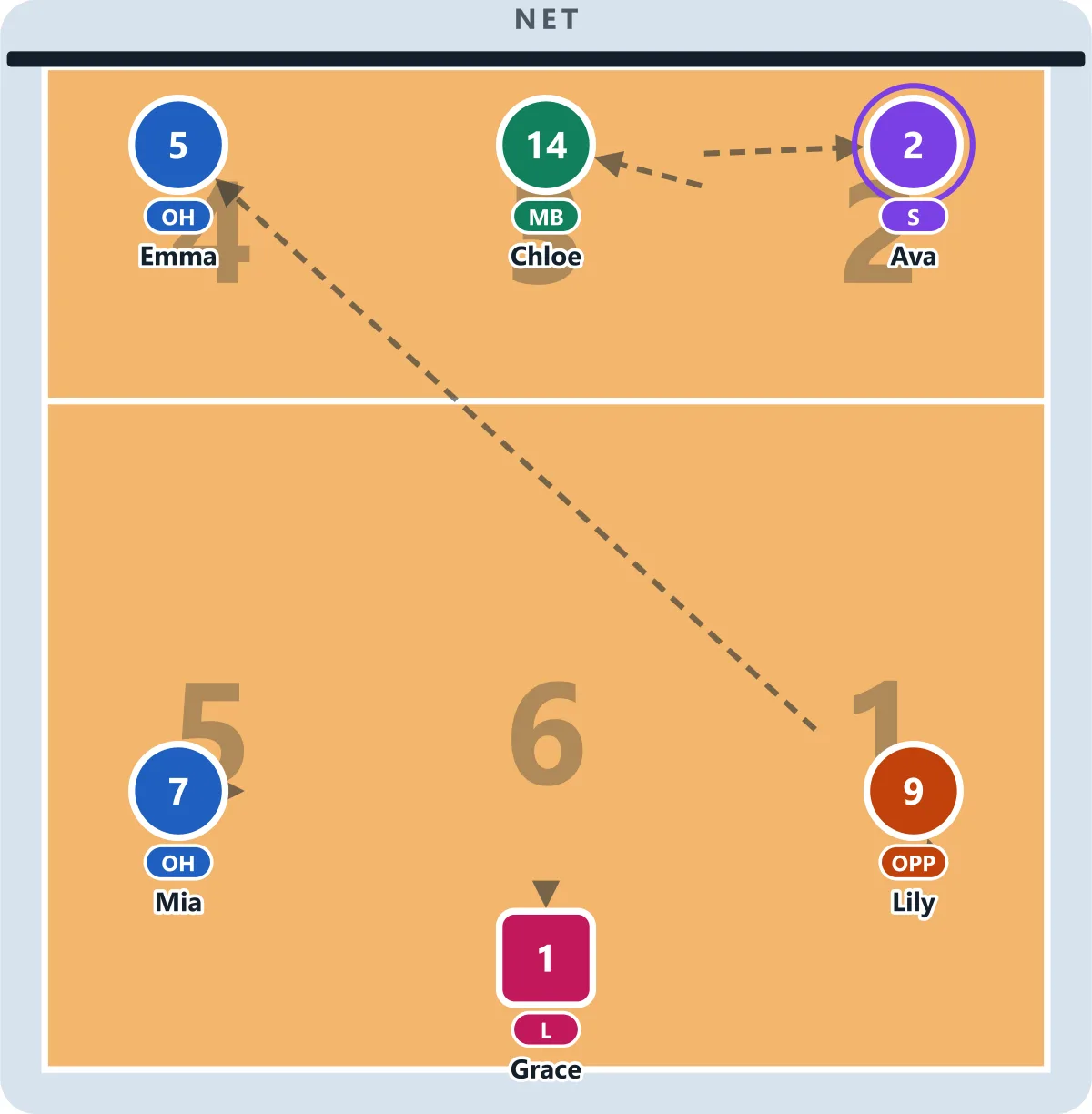
Overlap rules only apply at the serve contact, so switching after the serve is legal.
Which rotation should a 5-1 start in?
There is no rule about it, so pick the start that helps you score early. Three common choices:
- Rotation 1 (setter serves first). The setter starts in zone 1. If you win the toss and serve, she serves first, and your three-hitter rotations come first.
- Start your strongest rotation when receiving. Many coaches want their best serve receive pattern on the court for the first rally of a set.
- Hide the weak rotation. If Rotations 4-6 struggle, start so that your best server serves just before them, which can win you points before you reach them.
Whatever you pick, set “Start the set in” in the generator. The lineup sheet, player cards and match mode all follow it, and box I on the lineup sheet is filled with your real first server.
How to teach the 5-1 in practice
- Day one: teach the serving order and the zone numbers. Players say their zone out loud in each rotation.
- Walk serve receive one rotation at a time, then go to base defense on the coach’s whistle.
- Add a live serve. Freeze the drill at the serve contact and check overlap.
- Run “Where do I stand?” in teaching mode at the start of practice until every player answers fast.
Common 5-1 mistakes
- Hiding the setter illegally. In Rotation 1 the setter must be behind the zone 2 player and right of the zone 6 player. Use the live overlap check before you teach it.
- Writing the wrong player in box I. If you receive first, the first server is your zone 2 player. Fill the lineup sheet from the generator so it is always right.
- Forgetting the weak rotation. Plan a set play or a serving target for Rotations 4-6, when only two hitters are front row.
- Switching too early. Players may not switch until the server contacts the ball.
Printable 5-1 cheat sheet
Download the free 5-1 rotation cheat sheet (PDF): all six rotations on one page with arrows to base defense. For your own lineup, open the volleyball rotation generator and print a rotation sheet, player cards or a wall chart, or start from a blank volleyball rotation sheet.
5-1 vs 6-2
Pick a 5-1 when you have one setter you trust. Pick a 6-2 when you have two setters and four or more good hitters, because it keeps three attackers in front every rotation. The systems comparison has a 3-question picker.
Frequently asked questions
What is a 5-1 in volleyball?
A 5-1 is an offense with one setter and five hitters. The same setter runs every rotation, from the back row and the front row. The number 5 counts the hitters and the 1 counts the setter. It is the most common system in high school, club and college volleyball because the hitters always connect with the same setter.
How do you run a 5-1 rotation in volleyball?
Put your setter in serving spot I, then an outside hitter, a middle, the opposite, the second outside and the second middle. The setter and opposite are across from each other. In serve receive, the libero and both outsides pass while the setter hides near the net, and in base defense the setter switches to the right side.
What is Rotation 1 in a 5-1?
Most coaches call the rotation with the setter in zone 1 (right back) Rotation 1. Then Rotation 2 is setter in zone 6, Rotation 3 is zone 5, and so on, in the order you play them. Some teams number rotations by their starting lineup instead. The generator lets you pick either naming.
How many hitters are in the front row in a 5-1?
Three when the setter is in the back row (Rotations 1, 2 and 3) and two when she is in the front row (Rotations 4, 5 and 6). In those front-row rotations the setter can still attack the second ball, which keeps blockers honest.
What is the difference between a 5-1 and a 6-2 in volleyball?
A 5-1 uses one setter for all six rotations. A 6-2 uses two setters who set only from the back row, so three hitters are always in the front row. The 5-1 gives one consistent set; the 6-2 gives an extra attacker but needs two setters and more substitutions.
How do you teach a 5-1 volleyball rotation?
Teach one rotation at a time, starting with Rotation 1. Walk players to their serve receive spots, then to base defense, and repeat each rotation until they find their spot without help. Print player cards that show each player where she stands, and use the quiz in teaching mode for quick reps.
Where does the libero go in a 5-1?
The libero usually replaces both middle blockers when they are in the back row, so she passes in the middle of the court. She comes in when a middle rotates to the back row and leaves when that spot rotates to zone 4. Under NFHS, USAV and NCAA rules she may serve in one rotation per set.
Rules checked
Rule sets used on this page: NFHS (high school) 2026-27, USAV (club) 2025-27, NCAA (college) 2026 and FIVB (international) 2025-28. Where leagues differ, the tool makes it a setting. Always check your league or state association.
- Overlap: server: USAV 7.4; NFHS 6-4-3
- Overlap: which pairs: USAV 7.4.2-7.4.3; NFHS 6-4-3
- Libero: where: NFHS 10-4-1a
- Libero: serving: USAV 7.7.1; NCAA 2024 (differs by league — check yours)
- Libero: how many: NFHS 6-4-2, 10-4-3 (2026-27)
Last reviewed: by EmproIT. See how we check the rules.